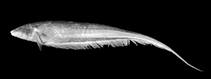
Classificação / Nomes
Nomes comuns | Sinónimos | Catalog of Fishes(Género, Espécies) | ITIS | CoL | WoRMS | Cloffa
>
Gymnotiformes (Knifefishes) >
Sternopygidae (Glass knifefishes) > Eigenmanninae
Etymology: Archolaemus: Greek, archo = anus + Greek, laimos = throat (Ref. 45335); janeae: Named for Jane Mertens of Humboldt Universität zu Berlin for her assistance to the second author.
Eponymy: Jane Mertens of the Faculty of Agriculture and Horticulture, Humboldt Universität zu Berlin was thanked “...for her assistance to the second author...” (Ref. 128868), visit book page.
Ambiente: milieu / zona climática / intervalo de profundidade / gama de distribuição
Ecologia
; Água doce bentopelágico; pH range: 5.5 - ?. Tropical; 31°C - ? (Ref. 93148)
South America: Rio Xingu and upper Rio Tapajós, Amazon basin, Brazil.
Tamanho / Peso / Idade
Maturidade: Lm ? range ? - ? cm
Max length : 40.2 cm TL macho/indeterminado; (Ref. 93148)
Descrição breve
Chaves de identificação | Morfologia | Morfometria
Raios anais moles: 205 - 228. Distinguished by the following combination of characters: gape relatively long, the rictus falling short posteriorly of the vertical through the posterior naris; the anteroposterior length of premaxilla equal to the transverse width; teeth on the dentary occupying most of the dorsal margin; two or three teeth arranged in a single row on the internal surface of the endopterygoid; 15-17 scales above the lateral line at the midbody; the length of the coronomeckelian bone less than 20% the length of Meckel’s cartilage; length of the
posterior ceratohyal 1.5 times the length of the ventral hypohyal; the length of the caudal filament 16.0-25.7% LEA; depth of the caudal filament 5.6-11.2% CL; presence of a narrow dark stripe along the lateral line and a broad band of dusky to dark pigmentation overlying the basal pterygiophores of the anal fin; 19-21 pectoral-fin rays; 205-228 anal-fin rays; head
length at the opercle 13.5-14.7% LEA (Ref. 93148).
Body shape (shape guide): elongated.
Collected in river with pronounced current that was faster towards the centre of the channel, with the substrate in the sampled areas formed by pebbly sand. Also found in the main stream of shallow rapids and small waterfalls, always over a rocky bottom (Ref. 93148).
Ciclo de vida e comportamento de acasalamento
Maturidade | Reprodução | Desova | Ovos | Fecundidade | Larvas
Vari, R.P., C.D. de Santana and W.B. Wosiacki, 2012. South American electric knifefishes of the genus Archolaemus (Ostariophysi, Gymnotiformes): undetected diversity in a clade of rheophiles. Zoological Journal of the Linnaean Society 165:670-699. (Ref. 93148)
Categoria na Lista Vermelha da IUCN (Ref. 130435: Version 2025-2 (Global))
Ameaça para o homem
Harmless
Utilização humana
Ferramentas
Relatórios especiais
Descarregue XML
Fontes da internet
Estimativas baseadas em modelos
Índice de diversidade filogenética (Ref.
82804): PD
50 = 0.5156 [Uniqueness, from 0.5 = low to 2.0 = high].
Bayesian length-weight: a=0.00219 (0.00123 - 0.00390), b=2.89 (2.72 - 3.06), in cm total length, based on LWR estimates for this species & (Sub)family-body (Ref.
93245).
Nível Trófico (Ref.
69278): 3.1 ±0.3 se; based on size and trophs of closest relatives
Vulnerabilidade da pesca (Ref.
59153): Low to moderate vulnerability (30 of 100).
🛈