Klassifizierung / Names
Namen | Synonyme | Catalog of Fishes(Gattung, Arten) | ITIS | CoL | WoRMS | Cloffa
>
Cyprinodontiformes (Rivulines, killifishes and live bearers) >
Poeciliidae (Poeciliids) > Poeciliinae
Etymology: Gambusia: Gambusia: From the Cuban term, Gambusino, which means "nothing", usually in the context of a joke or a farce. Fishing for gambusinos = when one catches nothing (Ref. 45335); quadruncus: Derived from the Latin quad (four) and uncus (hook) , in reference to the four hooked elements at the distal tip of the gonopodium.
Umwelt: Milieu / Klimazone / Tiefenbereich / Verbreitungsgebiet
Ökologie
; süßwasser benthopelagisch. Tropical
Central America: Mexico within the following drainages: Río Guayalejo-Tamesí, Río Pánuco, Laguna de Tamiahua, Río Tigre, Río Carrizal and Río Soto La Marina.
Größe / Gewicht / Alter
Geschlechtsreife: Lm ? range ? - ? cm
Max length : 2.8 cm SL Männchen/unbestimmt; (Ref. 91760)
Kurzbeschreibung
Bestimmungsschlüssel | Morphologie | Morphometrie
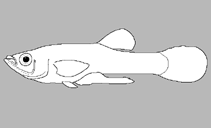
Rückenflossenweichstrahlen (insgesamt) : 7 - 9; Afterflossenweichstrahlen: 9 - 11; Wirbelzahl: 30 - 33. Belongs to the affinis species group and differs from all other members of this group by the following combination of characters: terminal hook at the distal tip of the gonopodium formed by rays 4a, 4p or both; elbow on gonopodial ray 4a positioned more distal relative to serrae (typically positioned one segment or more distal to serrae) and anal spots in females that are permanent, more prominent and positioned more posteriorly than other members (typically spanning the second to fifth or sixth rays) (Ref. 91760).
Body shape (shape guide): fusiform / normal.
Occurs in a wide range of habitats such as ponds, drainage ditches, lakes, wetlands, brackish lagoons, large rivers and swiftly flowing spring-fed streams (Ref. 91760).
Lebenszyklus und Paarungsverhalten
Geschlechtsreife | Fortpflanzung | Ablaichen | Eier | Fruchtbarkeit | Larven
Langerhans, R.B., M.E. Gifford, O. Domínguez-Domínguez, D. García-Bedoya and T.J. DeWitt, 2012. Gambusia quadruncus (Cyprinodontiformes: Poeciliidae): a new species of mosquitofish from east-central México. J. Fish Biol. 81(5):1514-1539. (Ref. 91760)
IUCN Rote Liste Status (Ref. 130435: Version 2025-2 (Global))
Bedrohung für Menschen
Harmless
Nutzung durch Menschen
Tools
Zusatzinformationen
Download XML
Internet Quellen
Schätzungen auf der Grundlage von Modellen
Phylogenetischer Diversitätsindex (Ref.
82804): PD
50 = 0.5000 [Uniqueness, from 0.5 = low to 2.0 = high].
Bayesian length-weight: a=0.01047 (0.00458 - 0.02392), b=3.14 (2.96 - 3.32), in cm total length, based on LWR estimates for this (Sub)family-body shape (Ref.
93245).
Trophische Ebene (Ref.
69278): 3.1 ±0.4 se; based on size and trophs of closest relatives
Widerstandsfähigkeit (Ref.
120179): hoch, Verdopplung der Population dauert weniger als 15 Monate. (Preliminary K or Fecundity.).
Anfälligkeit der Fischerei (Ref.
59153): Low vulnerability (10 of 100).
🛈