Ταξινόμηση / Ονόματα
Κοινά ονόματα | Συνώνυμα | Catalog of Fishes(Γένος, Είδη) | ITIS | CoL | WoRMS | Cloffa
>
Characiformes (Characins) >
Acestrorhamphidae (American tetras) > Acestrorhamphinae
Etymology: Astyanax: The name of Astyanax, Hector´s son in the Greek mythology (Ref. 45335); yariguies: Refers to the Yariguíes, the indigenous group that inhabited an area that includes the watershed of Río Cascajales. They fiercely defended their pristine territory for more than 400 years, which likely contributed to the preservation of the species described here. The Yariguíes finally succumbed to invasion and extermination in the mid-20th century. A noun in apposition.
Eponymy: Astyanax was the son of Hector in Greek mythology. See Homer’s Iliad for details. The reasoning for its use for a genus of characins is not explained. (Ref. 128868), visit book page.
Περιβάλλον: περιβάλλον / κλιματική ζώνη / εύρος βάθους / εύρος διανομής
Οικολογία
; Γλυκού νερού βενθοπελαγικό. Tropical
South America: tributaries of the Río Cascajales, in Río La Colorada basin, Río
Magdalena system in Colombia.
Μέγεθος / Βάρος / Ηλικία
Γεννητική Ωρίμανση: Lm ? range ? - ? cm
Max length : 7.7 cm SL αρσενικό/απροσδιόριστο; (Ref. 91755)
Σύντομη περιγραφή
Κλείδες προσδιορισμού | Μορφολογία | Μορφομετρία
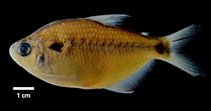
Μαλακές ραχιαίες ακτίνες (συνολικά) : 10 - 11; Μαλακές εδρικές ακτίνες: 31 - 33; Σπόνδυλοι: 35 - 37. Distinguished from other congeners by having the following characters: predorsal scale series regular with 13 scales; maxilla with six teeth; nine scale rows between dorsal-fin origin and lateral line; and snout length 14.9-25.3 % of head length. Can be separated easily from other characins (except for Astyanacinus orthodus) by its coloration pattern consisting of two humeral spots, midlateral stripe formed by anteriorly oriented chevron bars, and horizontally oriented oval-shaped caudal spot that continues over median caudal rays and never reaches a vertical through the last anal-fin ray base. Differs also from species of Astyanax by the combination of 6 teeth in maxilla, 13 scales in a regular predorsal series, 36-39 lateral line scales, 9 scale rows above and 7 scale rows below the lateral line, ii-iii 28-30 anal fin rays, and a maximum body depth 35.4-43.2% of SL (Ref. 91755).
Description:
Κύκλος ζωής και συμπεριφορά ζευγαρώματος
Γεννητική Ωρίμανση | Αναπαραγωγή | Γεννοβολία | Αβγά | Γονιμότητα | Προνύμφες
Torres-Mejia, M., E. Hernández and V. Senechal, 2012. A new species of Astyanacinus (Characiformes: Characidae) from the Río Magdalena System, Colombia. Copeia 2012(3):501-506. (Ref. 91755)
Κατάσταση Κόκκινου Καταλόγου IUCN (Ref. 130435: Version 2025-2 (Global))
Απειλή για τον άνθρωπο
Harmless
Ανθρώπινες χρήσεις
Εργαλεία
Ειδικές εκθέσεις
Λήψη XML
Διαδικτυακές πηγές
Εκτιμήσεις βάσει μοντέλων
Δείκτης φυλογενετικής ποικιλότητας (Αναφ.
82804): PD
50 = 0.5000 [Uniqueness, from 0.5 = low to 2.0 = high].
Bayesian length-weight: a=0.01047 (0.00452 - 0.02424), b=3.11 (2.93 - 3.29), in cm total length, based on LWR estimates for this Genus-body shape (Ref.
93245).
Τροφικό Επίπεδο (Αναφ.
69278): 2.9 ±0.4 se; based on size and trophs of closest relatives
Ελαστικότητα (Αναφ.
120179): Υψηλό, ελάχιστος χρόνος για διπλασιασμό πληθυσμού < 15 μήνες (Preliminary K or Fecundity.).
Ευπάθεια στην αλιεία (Ref.
59153): Low vulnerability (10 of 100).
🛈