>
Blenniiformes (Blennies) >
Blenniidae (Combtooth blennies) > Salariinae
Etymology: Hypleurochilus: Greek, hypo = under + Greek, pleura = in the side of + Greek, cheilos = lip; brasil: Named after the vivid red spots, similar to incandescent pieces of a brazing; Brazil’s country name (Brasil in Portuguese), where the species is endemic, originally has a similar derivation (name given in recognition of the reddish colour of the wood of a large Brazilian native tree - Caesalpinia echinata, 'Pau-Brasil' in Portuguese); noun in apposition.
Entorno: milieu / zona climática / rango de profundidad / gama de distribución
Ecología
marino asociado a arrecife; rango de profundidad 3 - 15 m (Ref. 94079). Tropical
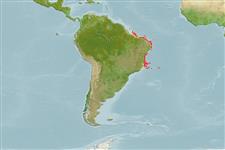
Western Atlantic: Brazil (Trindade Island and Martin Vaz).
Tamaño / Peso / Edad
Madurez: Lm ? range ? - ? cm
Max length : 3.1 cm SL macho / no sexado; (Ref. 94079); 2.7 cm SL (female)
Descripción breve
Claves de identificación | Morfología | Morfometría
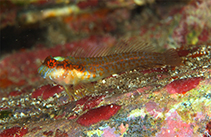
Espinas dorsales (total) : 12; Radios blandos dorsales (total) : 13 - 14; Espinas anales: 2; Radios blandos anales: 15 - 16; Vértebra: 36. This species is distinguished from its congeners by the following set of characters: pelvic-fin rays I, 3, dorsal fin usually XII,13, anal fin II,15-16 (usually 16), no blackened stripes, nape green or white and presence of numerous tiny red spots along body, diminishing in size posteriorly (Ref. 94079).
Body shape (shape guide): elongated.
Found either solitary or in small groups of up to 10 individuals; in small holes or associated with sea-urchins and sponges on the rocky reefs (Ref. 94079). Oviparous. Eggs are demersal and adhesive (Ref. 205), and are attached to the substrate via a filamentous, adhesive pad or pedestal (Ref. 94114). Larvae are planktonic, often found in shallow, coastal waters (Ref. 94114).
Ciclo vital y comportamiento de apareamiento
Madurez | Reproducción | Puesta | Huevos | Fecundidad | Larva
Pinheiro, H.T., J.L. Gasparini and C.A. Rangel, 2013. A new species of the genus Hypleurochilus (Teleostei: Blenniidae) from Trindade Island and Martin Vaz Archipelago, Brazil. Zootaxa 3709(1):95-100. (Ref. 94079)
Situación en la Lista Roja de la UICN (Ref. 130435: Version 2025-2 (Global))
Amenaza para el ser humano
Harmless
Usos humanos
Herramientas
Informes especiales
Descargar XML
Fuentes de Internet
Estimaciones basadas en modelos
Temperatura preferida (Referencia
123201): 25.8 - 27.6, mean 27.4 °C (based on 98 cells).
Índice de diversidad filogenética (Referencia
82804): PD
50 = 0.5005 [Uniqueness, from 0.5 = low to 2.0 = high].
Bayesian length-weight: a=0.00776 (0.00354 - 0.01702), b=3.00 (2.81 - 3.19), in cm total length, based on LWR estimates for this (Sub)family-body shape (Ref.
93245).
Nivel trófico (Referencia
69278): 3.1 ±0.3 se; based on size and trophs of closest relatives
Resiliencia (Referencia
120179): Alto, población duplicada en un tiempo mínimo inferior a 15 meses (Preliminary K or Fecundity.).
Vulnerabilidad pesquera (Ref.
59153): Low vulnerability (10 of 100).
🛈