>
Gobiiformes (Gobies) >
Gobiidae (Gobies) > Gobiinae
Etymology: Gobiodon: Latin, gobius = gudgeon + Greek, odous = teeth (Ref. 45335); bilineatus: Named for its two distinct, bright blue lines through the eye, the remaining distinct colour pattern that remains in the largest adults when alive; from Latin words 'bi' for two and 'linea' for line.
Miljö: miljö / Klimatzon / djupintervall / distributionsområde
Ekologi
marina revassocierade. Tropical
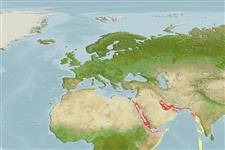
Indo-West Pacific: most probalby within the whole area; collected from the Gulf of Aqaba, Red Sea.
Storlek / Vikt / Ålder
Könsmognad: Lm ? range ? - ? cm
Max length : 3.6 cm SL hane/ej könsbestämd; (Ref. 94082)
Kort beskrivning
Bestämningsnycklar | Morfologi | Morfometri
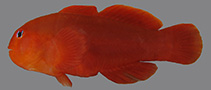
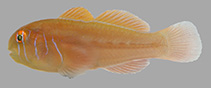
Taggstrålar i ryggfenan (totalt) : 6; Mjukstrålar i ryggfenan (totalt) : 10 - 11; Taggstrålar i analfenan: 1; Mjukstrålar i analfenan: 8; Ryggkotor: 26. This species is distinguished by the following characters: D VI+I,10-11; A I,8-9 (usually 9); head and body naked; body slightly compressed and relatively elongate (body depth at pelvic-fin origin 36-40% SL), dorso-ventrally symmetrical; distance between D1 insertion and dorsal insertion of pectoral-fin 53-71% of head length; rounded head with upper lip curved; small mouth, upper jaw extending to anterior margin of the eye; groove between isthmus and interopercle absent; caudal peduncle deep (minimal depth 16.3-17.9% SL); caudal fin relatively short (21.7-23.2% SL). Colour of juveniles and subadults light greenish or reddish with 5 vertical blue lines on head while adults are usually uniformly orange-red or dark red, sometimes with remnants of lines on the head but always with 2 distinct bluish lines through the eyes, sometimes extending ventrally to suborbital area; dorsal and anal fin usually with a narrow light bluish band along bases, fading with growth (Ref. 94082).
Body shape (shape guide): short and / or deep; Cross section: compressed.
Facultative air-breathing in the genus (Ref. 126274); Usually occupies the reef slope and fore reef areas and often in large colonies of Acropora samoensis but also present in Acropora secale and A. gemmifera in northern Red Sea (Ref. 94082).
Livscykel och parningsbeteende
Könsmognad | Reproduktion | Lek | Ägg | Fekunditet | Larver
Herler, J., S.V. Bogorodsky and T. Suzuki, 2013. Four new species of coral gobies (Teleostei: Gobiidae: Gobiodon), with comments on their relationships within the genus. Zootaxa 3709(4):301-329. (Ref. 94082)
Status på IUCN:s rödlista (Ref. 130435: Version 2025-2 (Global))
Hot mot människor
Harmless
Mänskliga användningsområden
Verktyg
Särskilda rapporter
Ladda ner XML
Internet-källor
Uppskattningar baserade på modeller
Önskad temperatur (Ref.
123201): 24.8 - 29.3, mean 28 °C (based on 172 cells).
Index för fylogenetisk mångfald (Ref.
82804): PD
50 = 0.5000 [Uniqueness, from 0.5 = low to 2.0 = high].
Bayesian length-weight: a=0.01995 (0.00906 - 0.04395), b=3.01 (2.83 - 3.19), in cm total length, based on all LWR estimates for this body shape (Ref.
93245).
Trofisk nivå (Ref.
69278): 3.3 ±0.4 se; based on size and trophs of closest relatives
Resiliens (Ref.
120179): Hög, lägsta populationsfördubblingstid mindre än 15 månader (Preliminary K or Fecundity.).
Sårbarhet i fisket (Ref.
59153): Low vulnerability (10 of 100).
🛈