Clasificación / Nombres
Nombres comunes | Sinónimos | Catalog of Fishes(Género, Especie) | ITIS | CoL | WoRMS | Cloffa
>
Cyprinodontiformes (Rivulines, killifishes and live bearers) >
Procatopodidae (African lampeyes) > Procatopodinae
Etymology: Hylopanchax: Greek, hylo, hyle = material, wood + Panchax, a word created by Meinken in 1932; leki: The species name 'leki' is the Lingala word for the "smaller or younger sibling", referring to the fact that the species is the slightly smaller one of the sibling species Hylopanchax ndeko of the left bank of the Lokoro River (Ref. 94189).
Eponymy: The binomial is not an eponym but a word in the Lingala language for ‘smaller sibling’, referring to the fact that it is slightly smaller than a related species found in the same area. (Ref. 128868), visit book page.
Entorno: milieu / zona climática / rango de profundidad / gama de distribución
Ecología
; agua dulce pelágico. Tropical
Africa: Lokoro River near Lompolé, in the Salonga National Park (Mai Ndombe system, middle Congo River basin) in Democratic Republic of the Congo (Ref. 94189).
Tamaño / Peso / Edad
Madurez: Lm ? range ? - ? cm
Max length : 2.9 cm SL macho / no sexado; (Ref. 94189)
Descripción breve
Claves de identificación | Morfología | Morfometría
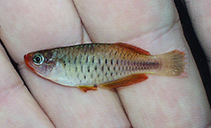
Espinas dorsales (total) : 0; Radios blandos dorsales (total) : 11 - 13; Espinas anales: 0; Radios blandos anales: 18 - 20; Vértebra: 30. Diagnosis: This species is distinguished from all other Hylopanchax species except for Hylopanchax ndeko, by the position of the dorsal fin (D/A = 8-10 vs. D/A = 11-14), the number of dorsal fin rays (11-13 vs. 6-9), the number of pectoral fin rays (11-13 vs. 8-10), the number of transversal scales (19-20 vs. 15-16), by its deep body (29.2-35.5% of standard length vs. 16.3-25.6% of standard length), by the low caudal peduncle ration (1.2-1.7 vs. 1.6-2.4), and by having 2 or 3 rows of scales underneath the eye versus 1 row of scales; it has also longer dorsal spines of vertebrae at mid-body versus short dorsal spines with lower length differences between mid-body and anterior or posterior spines (Ref. 94189). It is distinguished from Hylopanchax ndeko by having fewer scales in the longitudinal series (m21-23 vs. 24-26), prominent lobes of the supra-temporal neuromast system and male colour pattern; snout, lower jaw, and anterior part of throat dark orange versus yellow snout and lower jaw and white throat in H. ndeko; flanks just below dorsal fin with orange shine versus purple shine, dorsal and anal fin dark orange versus yellow anal and dorsal fin with a red distal submarginal stripe and a nearly transparent margin, white edged caudal fin olive brown with orange shine versus white edged blue caudal fin (Ref. 94189).
Cross section: compressed.
Collected in a small shady stream (Ref. 94189).
Ciclo vital y comportamiento de apareamiento
Madurez | Reproducción | Puesta | Huevos | Fecundidad | Larva
van der Zee, J.R., R. Sonnenberg and U.K. Schliewen, 2013. Description of three new species of Hylopanchax Poll & Lambert, 1965 from the central Congo basin (Cyprinodontiformes: Poeciliidae: Procatopodini) with a redefinition of the genus. Zootaxa 3701(1):35-53. (Ref. 94189)
Situación en la Lista Roja de la UICN (Ref. 130435: Version 2025-2 (Global))
Amenaza para el ser humano
Harmless
Usos humanos
Herramientas
Informes especiales
Descargar XML
Fuentes de Internet
Estimaciones basadas en modelos
Índice de diversidad filogenética (Referencia
82804): PD
50 = 0.5039 [Uniqueness, from 0.5 = low to 2.0 = high].
Bayesian length-weight: a=0.00562 (0.00224 - 0.01412), b=3.07 (2.85 - 3.29), in cm total length, based on LWR estimates for this (Sub)family-body shape (Ref.
93245).
Nivel trófico (Referencia
69278): 3.1 ±0.4 se; based on size and trophs of closest relatives
Vulnerabilidad pesquera (Ref.
59153): Low vulnerability (10 of 100).
🛈