Classification / Noms
Noms communs | Synonymes | Catalog of Fishes(Genre, Espèce) | ITIS | CoL | WoRMS | Cloffa
>
Siluriformes (Catfishes) >
Trichomycteridae (Pencil or parasitic catfishes) > Trichomycterinae
Etymology: Trichomycterus: Greek, thrix = hair + Greek, mykter, -eros = nose (Ref. 45335); minus: The name 'minus', in reference to the English word, mine, alludes to the mining activities common in the portion of the Province of Catamarca where the species was captured.
Environnement : milieu / zone climatique / profondeur / gamme de distribution
Écologie
; eau douce démersal; profondeur ? - 1 m (Ref. 94174). Subtropical
South America: Río Cuevas in Argentina.
Taille / Poids / Âge
Maturité: Lm ? range ? - ? cm
Max length : 7.5 cm SL mâle / non sexé; (Ref. 94174)
Description synthétique
Clés d'identification | Morphologie | Morphométrie
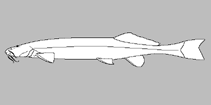
Rayons mous dorsaux (Total) : 11 - 14; Vertèbres: 36. Diagnosed from other species of Trichomycterus , except T. alterus, T. aguarague , T.belensis , T. boylei, and T. ramosus, by having 3 supraorbital pore, discontinuous supraorbital canal, expanded supraorbital tendon bone, and the premaxilla equal in size to, or smaller than, the maxilla. Can be separted from these five species by the following characters: non-enlarged base of the maxillary barbel, thick rugose layer of fatty tissue on the head and body absent; and integument on the surface of the interopercle not covering the odontodes. Can be further differentiated from T. alterus in the only slightly compressed caudal peduncle, presence of dark pigmentation on the area of the body anteroventral to the dorsal-fin origin not covering the odontodes, and the profile of the head from a dorsal view which is not much wider posteriorly than anteriorly; from T. aguarague in having four or five premaxillary tooth rows; from T. belensis in the uniformly brown pigmentation on the body and the lack of dark pigmentation on the basal portions of the caudal-fin rays; from T. boylei in the profile of the head from a dorsal view which is not much wider posteriorly than anteriorly; and from T. ramosus in the distally unbranched barbels of variable width along their length (Ref. 94174).
Found in a small, silt-laden stream with 0.2 to 1.0 m depth, 1.0 to 2.5 m width over a sand and rock bottom without aquatic vegetation, flow rate 0.037m3/s, conductivity 0.614 mS/ cm, turbidity 10, dissolved oxygen 4.96 mg/l, and temperature 20°C. Hides under rocks. Feeds on autochthonous benthic macroinvertebrates (dipteran larvae and Ephemeroptera) (Ref. 94174)
Cycle de vie et comportement reproducteur
Maturité | Reproduction | Frai | Œufs | Fécondité | Larves
Fernández, L. and R.P. Vari, 2012. New species of Trichomycterus (Teleostei: Siluriformes) from the Andean Cordillera of Argentina and the second record of the genus in thermal waters. Copeia 2012(4):631-636. (Ref. 94174)
Statut dans la liste rouge de l'IUCN (Ref. 130435: Version 2025-2 (Global))
Menace pour l'homme
Harmless
Utilisations par l'homme
Outils
Articles particuliers
Télécharger en XML
Sources Internet
Estimations basées sur des modèles
Indice de diversité phylogénétique (Réf.
82804): PD
50 = 0.5000 [Uniqueness, from 0.5 = low to 2.0 = high].
Bayesian length-weight: a=0.00912 (0.00396 - 0.02102), b=2.97 (2.79 - 3.15), in cm total length, based on LWR estimates for this Genus-body shape (Ref.
93245).
Niveau trophique (Réf.
69278): 3.2 ±0.4 se; based on size and trophs of closest relatives
Vulnérabilité de la pêche (Ref.
59153): Low vulnerability (10 of 100).
🛈