>
Eupercaria/misc (Various families in series Eupercaria) >
Priacanthidae (Bigeyes or catalufas)
Etymology: Pristigenys: Greek, pristis = saw + Greek, genys, -yos = face (Ref. 45335).
Entorno: milieu / zona climática / rango de profundidad / gama de distribución
Ecología
marino asociado a arrecife; rango de profundidad 80 - 100 m (Ref. 4328). Tropical
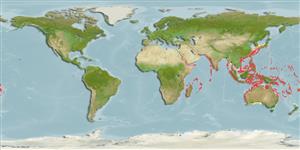
Indo-West Pacific: eastern coast of Africa; north to Japan; south to Indonesia.
Tamaño / Peso / Edad
Madurez: Lm ? range ? - ? cm
Max length : 27.4 cm SL macho / no sexado; (Ref. 94109)
Descripción breve
Claves de identificación | Morfología | Morfometría
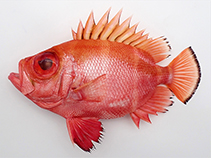
Espinas dorsales (total) : 10; Radios blandos dorsales (total) : 10 - 12; Espinas anales: 3; Radios blandos anales: 10. Distinguished from its congeners by the following set of characters: D X,11; A III,10; total gill rakers on first arch 23-26, mode 24 (upper limb 6-9, lower 16-18); lateral-line scales 31-37, mode 33; body scales above pectoral fin with about 11-40 spinules on posterior margin, the number increasing with growth up to ca. 20 cm SL; rounded caudal fin in young and adults; colour of posterior soft portions of vertical fins hyaline reddish with black margins, width about 1/4 of pupil diameter in fresh specimens (usually distinct in preservation); 5 white or pale relatively narrow vertical bands on body, the third around 1/4-2/5 width of pupil, somewhat expanded dorsally and ventrally, and relatively vertical throughout, including dorsal and ventral extremities (Ref. 94109).
Body shape (shape guide): short and / or deep; Cross section: compressed.
Ciclo vital y comportamiento de apareamiento
Madurez | Reproducción | Puesta | Huevos | Fecundidad | Larva
Iwatsuki, Y., T. Matsuda, W.C. Starnes, T. Nakabo and T. Yoshino, 2012. A valid priacanthid species, Pristigenys refulgens (Valenciennes 1862), and a redescription of P. niphonia (Cuvier in Cuvier & Valenciennes 1829) in the Indo-West Pacific (Perciformes: Priacanthidae). Zootaxa 3206:41-57. (Ref. 94109)
Situación en la Lista Roja de la UICN (Ref. 130435: Version 2025-2 (Global))
Amenaza para el ser humano
Harmless
Usos humanos
Herramientas
Informes especiales
Descargar XML
Fuentes de Internet
Estimaciones basadas en modelos
Temperatura preferida (Referencia
123201): 16.3 - 27.1, mean 23.9 °C (based on 108 cells).
Índice de diversidad filogenética (Referencia
82804): PD
50 = 0.5312 [Uniqueness, from 0.5 = low to 2.0 = high].
Bayesian length-weight: a=0.02239 (0.00941 - 0.05325), b=2.93 (2.72 - 3.14), in cm total length, based on LWR estimates for this (Sub)family-body shape (Ref.
93245).
Nivel trófico (Referencia
69278): 3.9 ±0.5 se; based on size and trophs of closest relatives
Resiliencia (Referencia
120179): Alto, población duplicada en un tiempo mínimo inferior a 15 meses (Preliminary K or Fecundity.).
Vulnerabilidad pesquera (Ref.
59153): Low vulnerability (23 of 100).
🛈