Classification / Noms
Noms communs | Synonymes | Catalog of Fishes(Genre, Espèce) | ITIS | CoL | WoRMS | Cloffa
>
Osteoglossiformes (Bony tongues) >
Arapaimidae (Bonytongues)
Etymology: Arapaima: From tupí-guaraní, arapaima (Ref. 45335).
Eponymy: Jean Louis Rudolphe Agassiz (1807–1873) was a Swiss-American geologist, glaciologist and zoologist whose speciality was ichthyology. [...] (Ref. 128868), visit book page.
Environnement : milieu / zone climatique / profondeur / gamme de distribution
Écologie
; eau douce benthopélagique. Tropical
South America: known only from the holotype from Brazilian Amazon.
Taille / Poids / Âge
Maturité: Lm ? range ? - ? cm
Description synthétique
Clés d'identification | Morphologie | Morphométrie
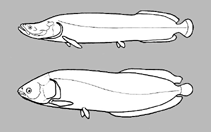
Can be diagnosed from its congeners by possessing the following characters: 44 dentary teeth, counted on single ramous only; 43 maxillary teeth; orbit diameter 1.5, relatively small compared to similar-sized individuals; interorbital width 4.1, relatively narrow; parietals with pronounced posterior projections that are pointed and curve slightly toward the midline; caudal fin widely separated from dorsal and anal fins by relatively long caudal peduncle, 9.7; caudal-peduncle length divided by peduncle depth 2.4; 26 anal-fin rays, with distinctly shorter basal length than that of dorsal fin; dorsal and anal fins extremely low in profile (dorsal-fin base divided by longest dorsal-fin ray about 7; longest dorsal-fin ray in anterior third of fin); and first pectoral-fin ray not (or only slightly) enlarged in diameter and with proximal tip similar in form to second and subsequent pectoral-fin rays. Can be further distinguished from Arapaima gigas by having single row of small teeth on dentary (vs. 2-2.5 rows of enlarged teeth in A. gigas ) (Ref. 93668).
Body shape (shape guide): elongated.
Obligate air-breathing (Ref. 126274)
Cycle de vie et comportement reproducteur
Maturité | Reproduction | Frai | Œufs | Fécondité | Larves
Stewart, D.J., 2013. Re-description of Arapaima agassizii (Valenciennes), a rare fish from Brazil (Osteoglossomorpha: Osteoglossidae). Copeia 2013(1):38-51. (Ref. 93668)
Statut dans la liste rouge de l'IUCN (Ref. 130435: Version 2025-2 (Global))
Menace pour l'homme
Harmless
Utilisations par l'homme
Outils
Articles particuliers
Télécharger en XML
Sources Internet
Estimations basées sur des modèles
Indice de diversité phylogénétique (Réf.
82804): PD
50 = 0.5469 [Uniqueness, from 0.5 = low to 2.0 = high].
Bayesian length-weight: a=0.00389 (0.00180 - 0.00842), b=3.12 (2.94 - 3.30), in cm total length, based on all LWR estimates for this body shape (Ref.
93245).
Niveau trophique (Réf.
69278): 3.4 ±0.4 se; based on size and trophs of closest relatives
Résilience (Réf.
120179): Faible, temps minimum de doublement de population : 4,5 à 14 années (Preliminary K or Fecundity.).
Vulnérabilité de la pêche (Ref.
59153): Very high vulnerability (90 of 100).
🛈