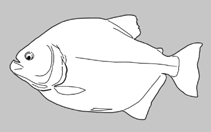
Clasificación / Nombres
Nombres comunes | Sinónimos | Catalog of Fishes(Género, Especie) | ITIS | CoL | WoRMS | Cloffa
>
Characiformes (Characins) >
Serrasalmidae (Piranhas and pacus) > Myleinae
Etymology: camunani: Name refers to 'camunani', its common name in the Wai-Wai language. The Wai-Wai inhabit the upper rio Trombetas basin, and consider the species of great cultural importance. The common name is also employed by local quilombolas (i.e., inhabitants of settlements founded by escaped slaves of African origin), who capture the fish using as bait the fruit of the camu-camu tree (Myrciaria dubia, Myrtaceae).
Entorno: milieu / zona climática / rango de profundidad / gama de distribución
Ecología
; agua dulce bentopelágico. Tropical
South America: upper rio Trombetas and its tributaries rio Mapuera, rio Cachorro, and
rio Erepecuru draining the Guiana Shield in Brazil.
Tamaño / Peso / Edad
Madurez: Lm ? range ? - ? cm
Max length : 91.1 cm SL macho / no sexado; (Ref. 93807)
Descripción breve
Claves de identificación | Morfología | Morfometría
Vértebra: 40 - 42. Differs from other species of Tometes by its neurocranium with a slight concavity at the level of the frontal bone (vs. concavity absent, dorsal profile of neurocranium straight). It can be further diagnosed among congeners by having five dentary teeth, 81-99 total scales in lateral-line, and 37-42 scales around caudal peduncle. It differs from T. trilobatus by having teeth with central cusp taller and acute (vs. central cusp shorter and with rounded edge); also from T. lebaili by a relatively shorter distance from snout to pectoral-fin origin, 19.1-24.2% SL (vs. 24.5-30.4% SL), shorter head length, 21.4-25.9% SL (vs. 26.6- 29.8% SL), and by possessing a terminal to scarcely subterminal mouth (vs. upturned mouth); from T. makue by having 12-26 prepelvic spines (vs. 0-9), 29-44 total spines (vs. 10-23), and by always possessing a pair of symphyseal dentary teeth, behind the main series (vs. symphyseal dentary teeth sometimes absent) (Ref. 93807).
Body shape (shape guide): short and / or deep.
Gut contents of large specimens measuring 17.5-38.2 cm SL are composed mainly of leaves of Podostemaceae, and fragments of grass and whole seeds of Myrtaceae and Fabaceae. Two smallest specimens examined measuring 9.08 and 13.3 cm SL feed mainly on fragments of Podostemaceae and benthic macroinvertebrates (Leptophlebiidae, Simuliidae and Chironomidae). All dissected specimens contain Oxyuroid nematodes (Rondonia rondoni) in their gastrointestinal tracts (Ref. 93807).
Ciclo vital y comportamiento de apareamiento
Madurez | Reproducción | Puesta | Huevos | Fecundidad | Larva
Andrade, M.C., T. Giarrizzo and M. Jégu, 2013. Tometes camunani (Characiformes: Serrasalmidae), a new species of phytophagous fish from the Guiana Shield, rio Trombetas basin, Brazil. Neotrop. Ichthyol. 11(2):297-306. (Ref. 93807)
Situación en la Lista Roja de la UICN (Ref. 130435: Version 2025-2 (Global))
Amenaza para el ser humano
Harmless
Usos humanos
Herramientas
Informes especiales
Descargar XML
Fuentes de Internet
Estimaciones basadas en modelos
Índice de diversidad filogenética (Referencia
82804): PD
50 = 0.5078 [Uniqueness, from 0.5 = low to 2.0 = high].
Bayesian length-weight: a=0.02399 (0.01109 - 0.05190), b=2.99 (2.80 - 3.18), in cm total length, based on LWR estimates for this (Sub)family-body shape (Ref.
93245).
Resiliencia (Referencia
120179): Medio, población duplicada en un tiempo mínimo de 1.4-4.4 años (Preliminary K or Fecundity.).
Vulnerabilidad pesquera (Ref.
59153): High to very high vulnerability (67 of 100).
🛈