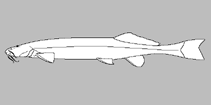
分类 / 名称
俗名 | 同种异名 | Catalog of Fishes(属, 种) | ITIS | CoL | WoRMS | Cloffa
Teleostei >
Siluriformes (Catfishes) >
Trichomycteridae (Pencil or parasitic catfishes) > Trichomycterinae
Etymology: Ituglanis: Greek, itys, ityos = circle + Greek, glanis = a fish that can eat the bait without touching the hook; a cat fish (Ref. 45335); agreste: The name agreste is from the Latin agrestis, meaning relative to land, field, wild, or rustic. This refers to eastern Brazil, encompassing the area between the Rio Grande do Norte State to the middle section of rio de Contas basin in Bahia State, that marks the transition between two distinct biomes, the Atlantic Forest and the semi-arid Caatinga, where the new species was discovered. A noun in apposition.
环境:氛围 / 气候带 / 深度上下限 / 分布范围
生态学
; 淡水 底中水层性; 深度上下限 0 - 2 m (Ref. 94155).
South America: Rio Gongogi drainage, rio de Contas basin in Brazil.
大小 / 重量 / 年龄
成熟度: Lm ? range ? - ? cm
Max length : 4.4 cm SL 雄鱼/尚未辨别雌雄; (Ref. 94155)
简单描述
检索表 | 型态特徵 | 形态测量图
背的软条 (总数) : 11 - 12; 臀鳍软条: 10 - 11; 脊椎骨: 36. This species is diagnosed from all congeners, except Ituglanis paraguassuensis, by the following characters: 36 vertebrae (vs. 38 or more in all other Ituglanis, except in I. paraguassuensis, I. nebulosus, I. bambui, I. epikarsticus, I. ramiroi, and I. passensis;
unknown for I. guayaberensis); 5-6 ribs (vs. 2 or 3 in I. amazonicus, I. eichorniarum, I. gracilior, I. ina, I. macunaima, I. nebulosus, and I. parkoi ; 4 in I. laticeps and I. cahyensis; 7 in I. passensis); i,6 pectoral-fin rays (vs. i,4 in I. cahyensis, I. macunaima, and I. parahybae ; i,5 in I. amazonicus, I. eichorniarum, I. metae, and I. nebulosus; i,7 in I. bambui, I. epikarsticus, I. mambai, I. passensis; iii,5 in I. guayaberensis; i,8 in I. ramiroi); and irregular brown blotches covering the skin (vs. distinct color pattern in all other Ituglanis; absence in I. ina and the subterranean species, I. bambui, I. passensis, I. epikarsticus, and I. ramiroi). Ituglanis agreste is also easily distinguished from the subterranean species by its large eyes (vs. minute eyes) and intense pigmentation (vs. pigmentation absent or almost lack); and from its geographically closest species I. paraguassuensis by having 26-30 odontodes in an elongate interopercle patch (vs. reduced with 14-15 odontodes); seven branchiostegal rays (vs. 8) and pore s1 lacking (vs. s1 present) (Ref. 94155).
Body shape (shape guide): elongated.
Occurs in a mid-small size river with width up to 8 m, in a moderate slope with clear and cold water, with transparency of about 2 m. The river is characterized by mainly turbulent water flow , with alternating areas of currents and pools, though a predominance of moderate to strong drifts. The substrate is composed of rocks and sand. Collected together with Astyanax bimaculatus (Linnaeus), Callichthys callichthys (Linnaeus), Geophagus brasiliensis (Quoy & Gaimard), Rhamdia quelen (Quoy & Gaimard) and Poecilia reticulata Peters (Ref. 94155).
生命周期和交配行为
成熟度 | 繁殖 | 产卵场 | 卵 | 孕卵数 | 仔鱼
Lima, S.M.Q., C.P. Neves and R.M. Campos-Paiva, 2013. Ituglanis agreste, a new catfish from the rio de Contas basin, northeastern Brazil (Siluriformes: Trichomycteridae). Neotrop. Ichthyol. 11(3):513-524. (Ref. 94155)
世界自然保护联盟红皮书 (Ref. 130435: Version 2025-2 (Global))
人类利用
工具
特别资料
下载 XML
网络资源
基于模型的估算
系统发育多样性指数 (参考文献
82804): PD
50 = 0.5000 [Uniqueness, from 0.5 = low to 2.0 = high].
Bayesian length-weight: a=0.00759 (0.00337 - 0.01709), b=3.00 (2.81 - 3.19), in cm total length, based on LWR estimates for this (Sub)family-body shape (Ref.
93245).
营养阶层 (参考文献
69278): 3.1 ±0.4 se; based on size and trophs of closest relatives
渔业脆弱性 (Ref.
59153): Low vulnerability (10 of 100).
🛈