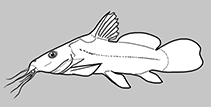
Classification / Noms
Noms communs | Synonymes | Catalog of Fishes(Genre, Espèce) | ITIS | CoL | WoRMS | Cloffa
>
Siluriformes (Catfishes) >
Auchenoglanididae (Flatnose catfishes)
Etymology: Notoglanidium: Greek, noton = back + Greek, glanis = a fish that can eat the bait without touching the hook; a cat fish; diminutive (Ref. 45335); pembetadi: The species name pembetadi refers to the local Kunyi name with 'tadi' meaning stone; based on some brief inquiries the meaning of 'pembe' remains unclear (Ref. 94483). Although the etymology has not been fully elucidated its Kunyi name seems to refer to the habitat where it lives, i.e., the large rocks and pebbles covering the bottom of the Kouilou-Niari River at Pont du Niari; the name was chosen to acknowledge that many of the new species discovered are already well known by the local inhabitants, and to express gratitude to the many children and fishermen who helped to collect the type series of this new species for science (Ref. 94483).
Environnement : milieu / zone climatique / profondeur / gamme de distribution
Écologie
; eau douce démersal. Tropical
Africa: Kouilou-Niari River basin in the Republic of the Congo (Ref. 94168, 94483).
Taille / Poids / Âge
Maturité: Lm ? range ? - ? cm
Max length : 17.9 cm SL mâle / non sexé; (Ref. 94483)
Description synthétique
Clés d'identification | Morphologie | Morphométrie
Épines dorsales (Total) : 2; Rayons mous dorsaux (Total) : 10 - 13; Épines anales: 0; Rayons mous anaux: 12 - 17; Vertèbres: 39 - 43. Diagnosis: Notoglanidium pembetadi differs from other species in the genus in having: a small predorsal body depth, 8.2-11.6% of standard length vs. larger in N. akiri, N. macrostoma, N. maculatum, N. thomasi and N. walkeri; a large horizontal distance between the bases of the anal and caudal fins, 15.7-18.6% of standard length vs. smaller in N. boutchangai, N. depierrei, N. macrostoma and N. maculatum; a small interorbital distance, 17.4-24.0% of head length vs. larger in N. akiri, N. macrostoma, N. maculatum, N. thomasi and N. walkeri; an average combined premaxillary tooth plate width, 20.8-26.4% of head length vs. larger in N. boutchangai and N. macrostoma, and smaller in N. maculatum, N. pallidum, N. thomasi and N. walkeri; and an average number of soft dorsal-fin rays, 10-13 vs. 7 rays in N. akiri, N. boutchangai and N. macrostoma, and 16-20 rays in N. maculatum (Ref. 94168, 94483).
Body shape (shape guide): elongated.
It is found between large rocks and pebbles covering the bottom of the Kouilou-Niari River at Pont du Niari (Ref. 94483).
Cycle de vie et comportement reproducteur
Maturité | Reproduction | Frai | Œufs | Fécondité | Larves
Geerinckx, T., E. Vreven, M. Dierick, L.V. Hoorebeke and D. Adriaens, 2013. Revision of Notoglanidium and related genera (Siluriformes: Claroteidae) based on morphology and osteology. Zootaxa 3691(1):165-191. (Ref. 94168)
Statut dans la liste rouge de l'IUCN (Ref. 130435: Version 2025-2 (Global))
Menace pour l'homme
Harmless
Utilisations par l'homme
Outils
Articles particuliers
Télécharger en XML
Sources Internet
Estimations basées sur des modèles
Indice de diversité phylogénétique (Réf.
82804): PD
50 = 0.5020 [Uniqueness, from 0.5 = low to 2.0 = high].
Bayesian length-weight: a=0.00525 (0.00219 - 0.01260), b=3.09 (2.87 - 3.31), in cm total length, based on LWR estimates for this (Sub)family-body shape (Ref.
93245).
Niveau trophique (Réf.
69278): 3.5 ±0.6 se; based on size and trophs of closest relatives
Résilience (Réf.
120179): Haut, temps minimum de doublement de population inférieur à 15 mois (Preliminary K or Fecundity.).
Vulnérabilité de la pêche (Ref.
59153): Low vulnerability (12 of 100).
🛈