>
Cichliformes (Cichlids, convict blennies) >
Cichlidae (Cichlids) > Pseudocrenilabrinae
Etymology: Pelvicachromis: Latin, pelvica, -ae = bassin + Greek, chromis = a fish, perhaps a perch (Ref. 45335); silviae: This species is dedicated to the author's wife Silvia as a 'thank you' in accepting long absences of the author, and in endurance of his usage of many resources for his work (Ref. 93865).
Eponymy: Silvia Lamboj, wife of the author, was honoured “…as a ‘thank you’ in accepting long absences of mine in mind and body, and in endurance of my usage of many resources for my work. [...] (Ref. 128868), visit book page.
Môi trường: môi trường / vùng khí hậu / Mức độ sâu / phạm vi phân phối
Sinh thái học
; nước ngọt sống nổi và đáy. Tropical
Africa: lower parts of the Niger River system (Ref. 93865).
Bộ gần gũi / Khối lượng (Trọng lượng) / Tuổi
Chín muồi sinh dục: Lm ? range ? - ? cm
Max length : 4.8 cm SL con đực/không giới tính; (Ref. 93865)
Mô tả ngắn gọn
Khóa để định loại | Hình thái học | Sinh trắc học
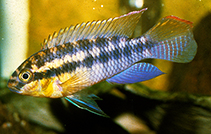
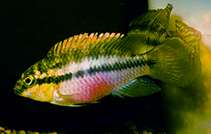
Các tia vây lưng cứng (tổng cộng) : 14 - 16; Các vây lưng mềm (tổng cộng) : 9 - 10; Tia cứng vây hậu môn: 3; Tia mềm vây hậu môn: 7 - 8. Diagnosis: Pelvicachromis silviae is distinguished from other species of Pelvicachromis by a combination of characters (Ref. 93865). It differs from P. subocellatus in somewhat greater body depth, being 37.4-43.0% of standard length vs. 34.5-41.6%; shorter snout length, 20.4-28.1% of head length vs. 23.4-30.9%; greater eye orbit diameter, 31.3-35.7% of head length vs. 28.9-32.9%; greater lower jaw length, 30.9-38.5% of head length vs. 25.4-35.3%; lesser scales between pelvic and pectoral, 3-5 vs. 5-6; in males in lappet-like elongation of some rays of caudal fin vs. no such elongation; and in females in greenish and yellow coloured parts on dorsal parts of body, situated over red belly region, vs. silver coloured scales around red belly region (Ref. 93865). It differs from P. sacramontis in greater body depth, being 37.4-43.0% of standard length vs. 29.0-36.5%; greater head length, 33.2-36.9% of standard length vs. 27.0-32.0%; greater caudal peduncle depth, 15.8-17.5% of standard length vs. 14.0-15.3%; shorter snout length, 20.4-28.1% of head length vs. 26.2-38.7%; greater postorbital distance, 40.4-45.7% of head length vs. 31.7-41.8%; shorter interorbital distance, 24.0-27.9% of head length vs. 29.4-45.3%; and shorter preorbital distance, 16.3-17.3% of head length vs. 18.7-26.5% (Ref. 93865). It differs from P. pulcher in greater body depth, being 37.4-43.0% of standard length vs. 32.6-38.3%; greater head length, 33.2-36.9% of standard length vs. 27.8-32.0%; greater caudal peduncle depth, 15.8-17.5% of standard length vs. 13.0-15.3%; shorter caudal peduncle length, 12.4-14.5% of standard length vs. 13.8-16.5%; shorter snout length, 20.4-28.1% of head length vs. 27.6-36.6%; greater postorbital distance, 40.4-45.7% of head length vs. 34.8-40.4%; shorter interorbital distance, 24.0-27.9% of head length vs. 25.9-33.1%; and shorter preorbital distance, 16.3-17.3% of head length vs. 21.0-33.8% (Ref. 93865). It differs from P. roloffi in greater body depth, being 37.4-43.0% of standard length vs. 33.6-37.6%; geater head length, 33.2-36.9% of standard length vs. 31.5-33.0%; greater caudal peduncle length, 15.8-17.5% of standard length vs. 9.4-12.2%; and higher number of pored scales of lateral line, 26-28 vs. 24-26 (Ref. 93865). It differs from P. taeniatus in greater body depth, being 37.4-43.0% of standard length vs. 29.9-36.4%; greater head length, 33.2-36.9% of standard length vs. 28.4-33.8%; greater pre-anal distance, 66.2-69.8% of standard length vs. 62.8-66.7%; greater prepelvic distance, 37.9-44.3% of standard length vs. 36.0-37.5%; shorter preorbital distance, 16.3-17.3% of head length vs. 18.6-21.1%; and fewer spines in dorsal fin, 14-16 vs. 17-18 (Ref. 93865). It differs from P. kribensis in greater body depth, being 37.4-43.0% of standard length vs. 30.4-37.3%; greater prepelvic distance, 37.9-44.3% of standard length vs. 32.5-37.7%; shorter preorbital distance, 16.3-17.3% of head length vs. 17.0-22.3%; and lesser spines in dorsal fin, 14-16 vs. 17-18 (Ref. 93865). It differs from P. sp. aff. taeniatus "Wouri" in greater body depth, being 37.4-43.0% of standard length vs. 28.7-35.1%; greater prepelvic distance, 37.9-44.3% of standard length vs. 33.4-39.5%; greater eye orbit diameter, 31.3-35.7% of standard length vs. 22.6-32.5%; more slender caudal peduncle, its length 73.2-85.3% of its depth vs. 93.9-124.6%; and fewer spines in dorsal fin, 14-16 vs. 17-18 (Ref. 93865). It differs from P. humilis, P. rubrolabiatus and P. signatus in absence of 7-8 vertical bars on body, visible in several behavioural situations; in three infraorbital bones vs. two; in greater body depth, 37.4-43.0% of standard length vs. 26.4-34.1%; shorter caudal peduncle length, 12.4-14.5% of standard length vs. 13.1-18.1%; greater anal-fin base length, 18.6-22.5% of standard length vs. 13.6-21.0%; shorter snout length, 20.4-28.1% of head length vs. 25.3-43.0%; greater interorbital distance, 24.0-27.9% of head length vs. 18.2-25.6%; and shorter preorbital depth, 16.3-17.3% of head length vs. 19.8-28.7% (Ref. 93865).
In aquaria, this species is a monogamous, pair bonding cave-spawner; frequently imported to Europe and North America for ornamental fish trade; seems not to be rare (Ref. 93865).
Vòng đời và hành vi giao phối
Chín muồi sinh dục | Sự tái sinh sản | Đẻ trứng | Các trứng | Sự sinh sản | Ấu trùng
Lamboj, A., 2013. A new dwarf cichlid (Perciformes) from Nigeria. Cybium 37(3):149-157. (Ref. 93865)
Tình trạng Sách đỏ IUCN (Ref. 130435: Version 2025-2 (Global))
Mối đe dọa đối với con người
Harmless
Sử dụng của con người
Các công cụ
Báo cáo đặc biệt
Tải xuống XML
Các nguồn internet
Ước tính dựa trên mô hình
Chỉ số đa dạng phát sinh loài (Tài liệu tham khảo
82804): PD
50 = 0.5039 [Uniqueness, from 0.5 = low to 2.0 = high].
Bayesian length-weight: a=0.00389 (0.00180 - 0.00842), b=3.12 (2.94 - 3.30), in cm total length, based on all LWR estimates for this body shape (Ref.
93245).
Mức dinh dưỡng (Tài liệu tham khảo
69278): 3.2 ±0.4 se; based on size and trophs of closest relatives
Thích nghi nhanh (Tài liệu tham khảo
120179): Chiêù cao, thời gian nhân đôi của chủng quần tối thiểu là dưới 15 tháng (Preliminary K or Fecundity.).
Sự dễ bị tổn thương của nghề đánh cá (Ref.
59153): Low vulnerability (10 of 100).
🛈