>
Gobiiformes (Gobies) >
Gobiidae (Gobies) > Gobiinae
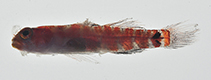
Etymology: Eviota: No etymology given, suggested by Christopher Scharpt: from Latin 'eu' for 'true' and 'iota' for anything very small, in combination 'truly very small' referring to it as being the smallest vertebrate at the time it has benn described by Jenkins (thus, making the suggestion by Scharpt plausible; dorsimaculata: Name formed from Latin 'dorsi' for back and 'maculata' meaning spot; refererring to the spot on the dorsal half of the caudal peduncle; noun in apposition.
Entorno: milieu / zona climática / rango de profundidad / gama de distribución
Ecología
marino bentopelágico; rango de profundidad 5 - 32 m (Ref. 94084). Tropical
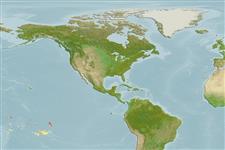
Eastern Central Pacific: Marquesas Islands.
Tamaño / Peso / Edad
Madurez: Lm ? range ? - ? cm
Max length : 1.4 cm SL macho / no sexado; (Ref. 94084)
Descripción breve
Claves de identificación | Morfología | Morfometría
Espinas dorsales (total) : 7; Radios blandos dorsales (total) : 8; Espinas anales: 1; Radios blandos anales: 7 - 8. This species is distinguished from its congeners by the following set of characters: dorsal/anal formula 8/8; branched pectoral-fin rays; 5th pelvic-fin ray less than 1/10 length of 4th ray, often rudimentary; a dark spot on caudal peduncle, usually restricted to above lateral midline; urogenital papilla not fimbriate or rugose (Ref. 94084).
Body shape (shape guide): elongated; Cross section: oval.
Known from rocky reefs (Ref. 9484).
Ciclo vital y comportamiento de apareamiento
Madurez | Reproducción | Puesta | Huevos | Fecundidad | Larva
Tornabene, L., G.N. Ahmadia and J.T. Williams, 2013. Four new species of dwarfgobies (Teleostei: Gobiidae: Eviota) from the Austral, Gambier, Marquesas and Society Archipelagos, French Polynesia. Syst. Biodiver. 11(3):363-380. (Ref. 94084)
Situación en la Lista Roja de la UICN (Ref. 130435: Version 2025-2 (Global))
Amenaza para el ser humano
Harmless
Usos humanos
Herramientas
Informes especiales
Descargar XML
Fuentes de Internet
Estimaciones basadas en modelos
Temperatura preferida (Referencia
123201): 27.7 - 29.1, mean 28.1 °C (based on 68 cells).
Índice de diversidad filogenética (Referencia
82804): PD
50 = 0.5000 [Uniqueness, from 0.5 = low to 2.0 = high].
Bayesian length-weight: a=0.00692 (0.00281 - 0.01706), b=3.09 (2.92 - 3.26), in cm total length, based on LWR estimates for this Genus-body shape (Ref.
93245).
Nivel trófico (Referencia
69278): 3.0 ±0.3 se; based on size and trophs of closest relatives
Resiliencia (Referencia
120179): Alto, población duplicada en un tiempo mínimo inferior a 15 meses (Preliminary K or Fecundity.).
Vulnerabilidad pesquera (Ref.
59153): Low vulnerability (10 of 100).
🛈