Classificazione / Nomi
Nomi Comuni | Sinonimi | Catalog of Fishes(Genere, Specie) | ITIS | CoL | WoRMS | Cloffa
>
Characiformes (Characins) >
Lebiasinidae (Pencilfishes) > Pyrrhulininae
Etymology: Nannostomus: Latin, nannus = small + Greek, stoma = mouth (Ref. 45335).
Ambiente: milieu / zona climatica / distribuzione batimetrica / gamma di distribuzione
Ecologia
; acqua dolce benthopelagico. Tropical
South America: Venezuela.
Dimensione / Peso / Età
Maturità: Lm ? range ? - ? cm
Max length : 3.3 cm SL maschio/sesso non determinato; (Ref. 94659)
Breve descrizione
Chiavi di identificazione | Morfologia | Morfometria
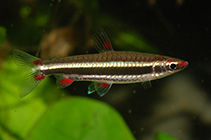
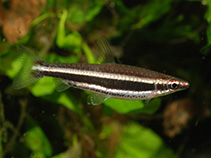
This species is similar to Nannostomus trifasciatus Steindachner, 1876 and N. erythrurus (Eigenmann, 1909), but it can be clearly distinguished by the following features of its coloration and pattern: exhibits sexual dichromatism, with males having ruby spots on the dorsal, anal, ventral fins and on the base of the caudal lobes while females having hyaline fins (vs. sexual dischormatism not developed in N. trifasciatus and N. erythrurus, with males and females having red spots on the dorsal, anal and vertral fins and on the base of the caudal lobes); primary horizontal stripe is relatively wide and somewhat lower, covering the lower part of the peduncle and ends on the caudal peduncle or is only a little bit on the caudal fin (vs. narrower, somewhat lower, covering the lower part of the peduncle and extends only onto the base (about 1/5th) of the three first lower caudal rays in N. trifasciatus; narrower and somewhat higher primary horizontal stripe not entirely covering the inferior part of the peduncle and extending onto the basal third or half of the three first lower caudal rays in N. erythrurus); and secondary horizontal stripe is relatively weakly developed, lower situated and extending to the end of the peduncle (vs. strongly developed, lower situated and extends to the end of the caudal peduncle in N. trifasciatus; somewhat higher, extending to the base of the adipose fin in N. erythrurus. N. nigrotaeniatus and N. erythrurus have no red stripe between primary and secondary horizontal band (vs. having one in N. trifasciatus, but this is only visible in living specimens) (Ref. 94659).
Body shape (shape guide): elongated.
Ciclo vitale e comportamento di accoppiamento
Maturità | Riproduzione | Deposizione | Uova | Fecondità | Larve
Zarske, A., 2013. Nannostomus nigrotaeniatus spec. nov. - ein neuer Ziersalmler aus Venezuela (Teleostei: Characiformes: Lebiasinidae). Verteb. Zool. 63(2):125-137. (Ref. 94659)
Stato della Lista Rossa IUCN (Ref. 130435: Version 2025-2 (Global))
Minaccia per l'uomo
Harmless
Usi umani
Strumenti
Rapporti speciali
Scarica XML
Fonti Internet
Stime basate su modelli
Indice di diversità filogenetica (Fonte Biblio.
82804): PD
50 = 0.5000 [Uniqueness, from 0.5 = low to 2.0 = high].
Bayesian length-weight: a=0.00646 (0.00280 - 0.01488), b=3.13 (2.93 - 3.33), in cm total length, based on LWR estimates for this (Sub)family-body shape (Ref.
93245).
Livello trofico (Fonte Biblio.
69278): 3.2 ±0.4 se; based on size and trophs of closest relatives
Vulnerabilità della pesca (Ref.
59153): Low vulnerability (10 of 100).
🛈