Classificazione / Nomi
Nomi Comuni | Sinonimi | Catalog of Fishes(Genere, Specie) | ITIS | CoL | WoRMS | Cloffa
>
Siluriformes (Catfishes) >
Auchenipteridae (Driftwood catfishes) > Centromochlinae
Etymology: Ferrarissoaresia: Named after C. Ferrarris and Soares; meridionalis: The specific name makes reference to the record of a Centromochlus species in southern Brazilian Amazon, a region referred to as 'Meridional Amazon'. This species is the single species in the genus originally described from Meridional Amazon, and with distribution apparently restricted to this region.
Eponymy: Dr Luisa Maria Sarmento-Soares Porto is an ichthyologist at the Museu de Bologia. [...] (Ref. 128868), visit book page.
Ambiente: milieu / zona climatica / distribuzione batimetrica / gamma di distribuzione
Ecologia
; acqua dolce benthopelagico. Tropical
South America: Rrio Teles Pires, rio Tapajós drainage in Mato Grosso State, Brazil.
Dimensione / Peso / Età
Maturità: Lm ? range ? - ? cm
Max length : 6.2 cm SL maschio/sesso non determinato; (Ref. 94696)
Breve descrizione
Chiavi di identificazione | Morfologia | Morfometria
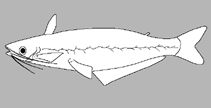
Spine dorsali (totale) : 1; Raggi dorsali molli (totale) : 5; Raggi anali molli: 9 - 10; Vertebre: 29. This species can be diagnosed from other species of Centromochlus by having eye diameter less than 16% of Head Length (vs. 20-35%). It differs from C. heckelii, C. existimatus, C. altae, and C. perugiae by absence of anterior nuchal plate (vs. presence); from C. concolor, C. reticulatus, C. macracanthus, C. punctatus, and C. schultzi, by having smooth anterior margin of dorsal spine (vs. with serrae); and from C. romani by a trapezoid quadrate, with metapterygoid in contact with hyomandibula (vs. enlarged quadrate, interposed between metapterygoid and hyomandibula). It can be further distinguished from C. heckelii and C. existimatus by having pectoral-fin spine 20-25% of SL (vs. 29- 42%) and 6 branched anal-fin rays (vs. 4 or 5); and from all congeners, except C. perugiae and C. romani, by having male modified anal fin with enlarged third unbranched ray, about twice thicker than first unbranched ray (Ref. 94696).
Body shape (shape guide): elongated.
Found in 1st and 2nd order streams, with 1.22 to 3.16 m in width and 0.17 to 0.72 m in depth, characterized by clear water and slow current that varies from 0.15 to 0.36 cm/s, over sand bottom with litter, and riparian surrounding vegetation. Collected under trunks and principally inset somewhat compressed submerged litter banks. Nocturnal. Feeds on small fish (Moenkhausia phaeonota, Characidae), shrimps, aquatic insect larvae and nymphs, fragments of terrestrial arthropods (ants, spiders), seeds and particulate organic matter. Syntopic with Astyanax sp., Bryconops spp., Knodus heteresthes, Moenkhausia spp., Erythrinus erythrinus, Hoplerythrinus unitaeniatus, Rivulus kayabi, Gymnotus aff. carapo, Gymnorhamphichthys petiti, Eigenmannia aff. trilineata, Aequidens sp., Crenicichla inpa, Tatia strigata, Tatia neivai, Helogenes marmoratus, Cetopsis sandrae, small unidentified cetopsid, Hisonotus spp., Cetopsorhamdia sp., Imparfinis aff. stictonotus, Phenacorhamdia somnians, Rhamdia quellen, Ituglanis aff. amazonicus, and Synbranchus sp. (Ref. 94696).
Ciclo vitale e comportamento di accoppiamento
Maturità | Riproduzione | Deposizione | Uova | Fecondità | Larve
Sarmento-Soares, L.M., F.G. Cabeceira, L.N. Carvalho, J. Zuanon and A. Akama, 2013. Centromochlus meridionalis, a new catfish species from the southern Amazonian limits, Mato Grosso State, Brazil (Siluriformes: Auchenipteridae). Neotrop. Ichthyol. 11(4):797-808. (Ref. 94696)
Stato della Lista Rossa IUCN (Ref. 130435: Version 2025-2 (Global))
Minaccia per l'uomo
Harmless
Usi umani
Strumenti
Rapporti speciali
Scarica XML
Fonti Internet
Stime basate su modelli
Indice di diversità filogenetica (Fonte Biblio.
82804): PD
50 = 0.7500 [Uniqueness, from 0.5 = low to 2.0 = high].
Bayesian length-weight: a=0.00490 (0.00199 - 0.01208), b=3.10 (2.88 - 3.32), in cm total length, based on LWR estimates for this (Sub)family-body shape (Ref.
93245).
Livello trofico (Fonte Biblio.
69278): 3.2 ±0.4 se; based on size and trophs of closest relatives
Resilienza (Fonte Biblio.
120179): Alto, tempo minimo di raddoppiamento della popolazione meno di 15 mesi (Preliminary K or Fecundity.).
Vulnerabilità della pesca (Ref.
59153): Low vulnerability (10 of 100).
🛈