Lớp phụ Cá sụn (cá mập và cá đuối) (sharks and rays) >
Myliobatiformes (Stingrays) >
Aetobatidae (Pacific eagle rays)
Etymology: Aetobatus: Greek, aetos = eagle + Greek, batis, batidos = a ray (Raja sp.) (Ref. 45335); narutobiei: Named for its common name in the Japanese waters ‘Naru tobi-ei’ (pronounced ‘Nar-oo-tobee-ay’), Naru’ referring to Naru Island and ‘Tobi-ei’ the Japanese name used for eagle rays which translates to black kite (a bird); noun in apposition.
Eponymy: Though it looks as if it could be an eponym, the binomial combines ‘Naru’ (Naru Island, Japan) with ‘tobi-ei’ – the Japanese name for eagle rays. (Ref. 128868), visit book page.
Môi trường: môi trường / vùng khí hậu / Mức độ sâu / phạm vi phân phối
Sinh thái học
biển sống nổi và đáy. Subtropical
Northwest Pacific: eastern Vietnam, Hong Kong, China, Korea and southern Japan.
Bộ gần gũi / Khối lượng (Trọng lượng) / Tuổi
Chín muồi sinh dục: Lm ? range ? - 80 cm
Max length : 100.0 cm WD con đực/không giới tính; (Ref. 94821); 150.0 cm WD (female); Khối lượng cực đại được công bố: 14.4 kg (Ref. 94821); Khối lượng cực đại được công bố: 14.4 kg
Mô tả ngắn gọn
Khóa để định loại | Hình thái học | Sinh trắc học
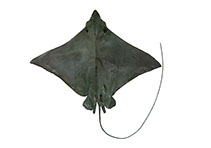
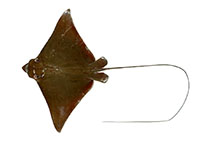
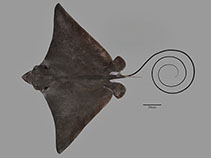
This medium to large-sized Aetobatus (reaching 150 cm DW) possess the following diagnostic characters: uniformly greenish grey to brownish dorsal surfaces, without pale spots or ocelli; long head, ventral length 27.4-31.9% DW; long to very long rostral lobe (longest in adult males) and narrow, tapering evenly to tip; single row of teeth plates, those in lower jaw chevron-shaped; width of lower tooth plate about 2.4 times its width and in about 18 series; 100-104 pectoral-fin radials (excluding propterygial radials anterior of eyes); 88-90 total vertebral centra (including synarcual); pelvic-fin radials 1 (with 2-5 fused elements) +17-18; males mature by about 80 cm DW; born at 33.4-35.2 cm DW (Ref. 94821).
Body shape (shape guide): other (see remarks); Cross section: flattened.
Found in shallow waters at water temperature above 15-17°C; in winter months, the species leave the shallower bays for nearby sea where water temperature is above 15°C brought by the Kuroshio current-derived warm waters (Ref. 94821).
Vòng đời và hành vi giao phối
Chín muồi sinh dục | Sự tái sinh sản | Đẻ trứng | Các trứng | Sự sinh sản | Ấu trùng
White, W.T., K. Furumitsu and A. Yamaguchi, 2013. A new species of Eagle ray Aetobatus narutobiei from the Northwest Pacific: an example of the critical role taxonomy plays in fisheries and ecological sciences. Plos One 8(12)e83785:1-12. (Ref. 94821)
Tình trạng Sách đỏ IUCN (Ref. 130435: Version 2025-2 (Global))
Mối đe dọa đối với con người
Harmless
Sử dụng của con người
Các công cụ
Báo cáo đặc biệt
Tải xuống XML
Các nguồn internet
Ước tính dựa trên mô hình
Chỉ số đa dạng phát sinh loài (Tài liệu tham khảo
82804): PD
50 = 0.5625 [Uniqueness, from 0.5 = low to 2.0 = high].
Bayesian length-weight: a=0.01000 (0.00244 - 0.04107), b=3.04 (2.81 - 3.27), in cm total length, based on all LWR estimates for this body shape (Ref.
93245).
Mức dinh dưỡng (Tài liệu tham khảo
69278): 3.6 ±0.5 se; based on size and trophs of closest relatives
Sự dễ bị tổn thương của nghề đánh cá (Ref.
59153): Very high vulnerability (83 of 100).
🛈