>
Mulliformes (Goatfishes) >
Mullidae (Goatfishes)
Etymology: Upeneus: Greek, ypene, -es = upper lip (Ref. 45335); heemstra: Named for Phil and Elaine Heemstra.
Eponymy: Dr Phillip Clarence Heemstra (1941–2019) was an American/South African marine ichthyologist and scientific diver. [...] (Ref. 128868), visit book page.
Taxonomic Remarks
FishBase common name changed from Heemstra goatfish to Heemstra's goatfish (Uiblein et al., 2024: Ref. 130857).
Entorno: milieu / zona climática / rango de profundidad / gama de distribución
Ecología
marino demersal; rango de profundidad 0 - 12 m (Ref. 95469). Tropical
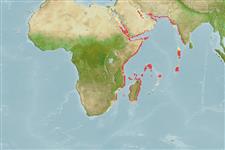
Western Indian Ocean: Mozambique to Central Red Sea, Seychelles, W India and Sri Lanka,
Tamaño / Peso / Edad
Madurez: Lm ? range ? - ? cm
Max length : 15.0 cm SL macho / no sexado; (Ref. 95469)
Descripción breve
Claves de identificación | Morfología | Morfometría
Espinas dorsales (total) : 8; Radios blandos dorsales (total) : 9; Espinas anales: 1; Radios blandos anales: 6. This species is distinguished by the following characters: D VIII + 9; pectoral-fin rays 12-14; gill rakers 4-8 + 14-18 = 19-24; lateral-line scales 28-30; in %SL: body depth at first dorsal-fin origin 22-26; body depth at anal-fin origin 19-23; caudal-peduncle depth 9.5-11; caudal-peduncle width 2.9-4.6; maximum head depth 19-22; head depth through eye 14-17; head length 27-31; postorbital length 10-13; orbit length 6.3-8.3; upper jaw length 9.8-13; barbel length 15-20; caudal peduncle
length 21-23; caudal-fin length 27-30; anal-fin height 16-19; pelvic-fin length 20-22; pectoral-
fin length 19-21; pectoral-fin width 3.7-4.9; first dorsal-fin height 19-23; second dorsal-fin height 17-18; postorbital length 1.4-1.8 times in anal-fin height; colour of all fins with red, brown or black
stripes, bars or blotches; caudal fin with 9-12 oblique bars, 4-6 bars on upper caudal-fin lobe
and 5-6 bars on lower caudal-fin lobe; first dorsal fin possess a large blotch around tip; one pale- or dark brown mid-lateral body stripe from tip of snout through eye to caudal base; body and head ground colour white or beige, slightly darker above lateral line, with irregular red, brown or black spots and/or blotches; fresh specimens with yellow or pale brown barbels; fin and body pigmentation mostly retained in preserved fish (Ref. 95469).
Body shape (shape guide): fusiform / normal; Cross section: oval.
Found over sand and mud bottoms near coral reefs (Ref. 30573); generally solitary (Ref. 5213). An invertebrate feeder (Ref. 41878).
Ciclo vital y comportamiento de apareamiento
Madurez | Reproducción | Puesta | Huevos | Fecundidad | Larva
Uiblein, F. and G. Gouws, 2014. A new goatfish species of the genus Upeneus (Mullidae) based on molecular and morphological screening and subsequent taxonomic analysis. Mar. Biol. Res. 10(7):655-681. (Ref. 95469)
Situación en la Lista Roja de la UICN (Ref. 130435: Version 2025-2 (Global))
Amenaza para el ser humano
Harmless
Usos humanos
Herramientas
Informes especiales
Descargar XML
Fuentes de Internet
Estimaciones basadas en modelos
Temperatura preferida (Referencia
123201): 26.2 - 29.1, mean 27.6 °C (based on 601 cells).
Índice de diversidad filogenética (Referencia
82804): PD
50 = 0.5000 [Uniqueness, from 0.5 = low to 2.0 = high].
Bayesian length-weight: a=0.00851 (0.00440 - 0.01645), b=3.07 (2.91 - 3.23), in cm total length, based on LWR estimates for this species & Genus-body shape (Ref.
93245).
Nivel trófico (Referencia
69278): 3.5 ±0.4 se; based on size and trophs of closest relatives
Resiliencia (Referencia
120179): Alto, población duplicada en un tiempo mínimo inferior a 15 meses (K=1.04;).
Vulnerabilidad pesquera (Ref.
59153): Low vulnerability (10 of 100).
🛈