رده بندی / نامها
اسامي عام | مترادف | Catalog of Fishes(جنس, گونه ها) | ITIS | CoL | WoRMS | Cloffa
>
Siluriformes (Catfishes) >
Loricariidae (Armored catfishes) > Hypostominae
Etymology: Spectracanthicus: Latin, spectrum = look, apparition + Greek, akantha = thorn (Ref. 45335); zuanoni: Named for Jansen Zuanon (INPA) due to his contribution to the knowledge of Neotropical Ichthyology. Jansen Zuanon was also the first ichthyologist who collected and identified this species as a new one.
Eponymy: Dr Jansen Alfredo Sampaio Zuanon is a Brazilian ichthyolgist and ecologist. [...] (Ref. 128868), visit book page.
محیط زیست: محیط زیست / منطقه آب و هوایی / تغييرات عمق / محدوده توزیع
بوم شناسي
; آب شيرين نزديك كف زي. Tropical
South America: Rio Xingu basin in Pará State, Brazil.
اندازه / وزن / سن
بلوغ: Lm ? range ? - ? cm
Max length : 24.0 cm TL جنس نر / بدون خواص جنسي; (Ref. 126097); بيشينه وزن گزارش شده: 220.00 g (Ref. 126097)
توصيف مختصر
كليدهاي شناسايي | ريخت شناسي | ريخت ستجي بوسيله انداره گيري
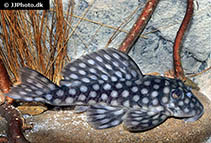
شعاع نرم باله پشتي (کل) : 8; شعاع نرم باله مخرجي: 5; مهره ها: 26. This is distinguished from other species of Spectracanthicus by its color pattern consisting of large, white spots (vs. small yellowish dots in S. murinus, S. punctatissimus, and S. tocantinensis , and dark gray lacking dots in S. immaculatus). It also differs from congeners, except S. murinus, by having larger orbital diameter up to 29.2% of HL (vs. up to 25.7% in S. punctatissimus, 20.3% in S. tocantinensis, 16.2% in S. immaculatus). It can be further separated from S. murinus by having rounded dorsal view of the snout, bar-shaped, eversible opercle with conspicuous odontodes, and four unbranched anal-fin rays (vs. snout slightly pointed; opercle triangle-shaped, not eversible, lacking conspicuous odontodes; three anal-fin unbranched rays); from S. tocantinensis by having 19-43 dentary teeth (vs. 8-16) and by the infraorbital 4 forming just a small area of orbit (vs. forming posterior edge of orbit almost totally) (Ref. 95496).
Body shape (shape guide): fusiform / normal.
Feeds actively at night on algae and other food items off periphyton by grazing over rock bottom. Found in rock-bottom areas subjected to backwater and strong currents. Occurs individually or in groups of three, under shelter boulders (adults) and spaces beneath rocks (juveniles), up to 2m deep. Juveniles co-inhabit with other loricariids such as Ancistrus sp., A. ranunculus, Baryancistrus xanthellus, Spectracanthicus punctatissimus , Hopliancistrus tricornis, Parancistrus nudiventris, Peckoltia vittata, and Pseudancistrus aff. barbatus (Ref. 95496).
چرخه زندگی و رفتار جفتگیری
بلوغ | تولید مثل | تخم ریزی | تخم ها | باروری | توزاد ( لارو)
Chamon, C.C. and L.H. Rapp Py-Daniel, 2014. Taxonomic revision of Spectracanthicus Nijssen & Isbrücker (Loricariidae: Hypostominae: Ancistrini), with description of three new species. Neotrop. Ichthyol. 12(1):1-25. (Ref. 95496)
وضعيت در فهرست قرمز IUCN (Ref. 130435: Version 2025-2 (Global))
خطر برای انسان ها
Harmless
استفاده انسانی
ماهي گيري – شيلات: تجاري; آكواريوم: تجاري
ابزارها
گزارش های ويژه
بارگيری XML
منابع اينترنتي
تخمینها بر اساس مدلها
شاخص تنوع فیلوژنتیکی (مرجع
82804): PD
50 = 0.5312 [Uniqueness, from 0.5 = low to 2.0 = high].
Bayesian length-weight: a=0.01072 (0.00421 - 0.02727), b=3.03 (2.81 - 3.25), in cm total length, based on LWR estimates for this (Sub)family-body shape (Ref.
93245).
جهندگی (مرجع
120179): متوسط, كمينه زمان لازم براي دو برابر شدن جمعيت 4/1 – 4/4 سال (Preliminary K or Fecundity.).
آسیبپذیری ماهیگیری (Ref.
59153): Low vulnerability (14 of 100).
🛈