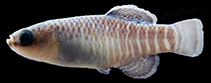
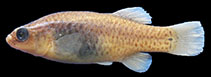
>
Cyprinodontiformes (Rivulines, killifishes and live bearers) >
Aphaniidae (Oriental killifishes)
Etymology: Esmaeilius: Named for Hamid Reza Esmaeili (Shiraz) for his extensive contribution to the understanding of diversity within this genus; darabensis: Links to Darab (the land of water) referring to Darab city, SE of Shiraz (Fars Province), as the species occurs in a spring near to this city.
Eponymy: Dr Hamid Reza Esmaeili is an Iranian biologist and ichthyologist at Shiraz University, Shiraz where he is full Professor of Ichthyology. [...] (Ref. 128868), visit book page.
Entorno: milieu / zona climática / rango de profundidad / gama de distribución
Ecología
; agua dulce bentopelágico. Subtropical
Asia: Kol River, Hormuzgan Basin in Iran.
Tamaño / Peso / Edad
Madurez: Lm ? range ? - ? cm
Max length : 3.9 cm SL macho / no sexado; (Ref. 95579)
Descripción breve
Claves de identificación | Morfología | Morfometría
Radios blandos dorsales (total) : 11 - 15; Radios blandos anales: 10 - 13. This species can be diagnosed from its closely related species Aphanius shirini
by having 9-18 flank bars in males (vs. 7-10), small irregular vertical patches of brown color on the flank of females (vs. prominent dark brown blotches of round or irregular shape), and symmetrically shaped triangular to trapezoid otoliths with a rostrum clearly longer than the antirostrum (vs. quadrangular to trapezoid otoliths with short and equally sized rostrum and antirostrum). It differs from other congeners by the combination of four characters in both sexes: longer anal fin (15.5% SL in males, 12.1% SL in females), larger pelvic fin (8.1-12.5% SL in males, 7.04-10.3% SL in females), greater scale width (4.1-6.0% SL), and otolith characters. Furthermore, males possess greater scale length (3.0-4.8% SL) and small caudal peduncle (0.9-1.5% minimum body depth); and females have short caudal fin length (12.7-19.2% SL) (Ref. 95579).
Body shape (shape guide): fusiform / normal.
Occurs in low numbers. Threatened mainly by drought and introductions of exotic species, particularly Gambusia holbrooki and Amatitlania nigrofasciata (Ref. 95579).
Ciclo vital y comportamiento de apareamiento
Madurez | Reproducción | Puesta | Huevos | Fecundidad | Larva
Freyhof, J. and B. Yoğurtçuoğlu, 2020. A proposal for a new generic structure of the killifish family Aphaniidae, with the description of Aphaniops teimorii (Teleostei: Cyprinodontiformes). Zootaxa 4810(3):421-451. (Ref. 126233)
Situación en la Lista Roja de la UICN (Ref. 130435: Version 2025-2 (Global))
Amenaza para el ser humano
Harmless
Usos humanos
Herramientas
Informes especiales
Descargar XML
Fuentes de Internet
Estimaciones basadas en modelos
Índice de diversidad filogenética (Referencia
82804): PD
50 = 0.5156 [Uniqueness, from 0.5 = low to 2.0 = high].
Bayesian length-weight: a=0.01072 (0.00652 - 0.01760), b=3.19 (3.06 - 3.32), in cm total length, based on LWR estimates for this species & Genus-body shape (Ref.
93245).
Nivel trófico (Referencia
69278): 2.9 ±0.4 se; based on size and trophs of closest relatives
Resiliencia (Referencia
120179): Alto, población duplicada en un tiempo mínimo inferior a 15 meses (Preliminary K or Fecundity.).
Vulnerabilidad pesquera (Ref.
59153): Low vulnerability (10 of 100).
🛈