>
Eupercaria/misc (Various families in series Eupercaria) >
Sparidae (Porgies)
Etymology: Acanthopagrus: Greek, akantha = thorn + Greek, pagros, a kind of fish (Ref. 45335); sheim: Named after the local Arabic name Sheim.
Ambiente: milieu / zona climatica / distribuzione batimetrica / gamma di distribuzione
Ecologia
marino demersale. Tropical
Western Indian Ocean: Persian Gulf.
Dimensione / Peso / Età
Maturità: Lm ? range ? - ? cm
Max length : 30.0 cm SL maschio/sesso non determinato; (Ref. 93743)
Breve descrizione
Chiavi di identificazione | Morfologia | Morfometria
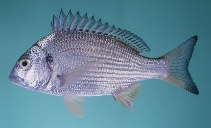
Spine dorsali (totale) : 11 - 12; Raggi dorsali molli (totale) : 10 - 11; Spine anali: 3; Raggi anali molli: 8. This species is characterized by the following: body relatively deep, 2.11-2.40 (mean 2.22); D XI,11 (rarely XII,10 or XI,10); scale rows between fifth dorsal-fin spine base and lateral line 4.5 ; scale rows above lateral line 5.5, below 11.5 or 12.5; second anal-fin spine strong [14.7-20.7% (mean 17.8%) of SL], 1.10-1.46 (mean 1.30) in 2AS/3AS; pored lateral-line scales 43-47 (mean 45.4); first soft dorsal-fin ray slightly longer than last dorsal-fin spine. Colour of fins: pale or strong yellow to bright yellow pelvic, anal, and caudal fins, lower caudal-fin lobe strong yellow, usually with wide dense black posterior margin; black streaks usually observed from middle to lowest portions on inter-radial membranes between yellow anal-fin rays, even in preserved specimens; two black blotches (rarely three irregular blotches) on lower inter-radial membranes between dorsal-fin rays; conspicuous diffuse dark blotch at origin of lateral line (covering first and second pored lateral line scales), continuing as dense blackish shading over upper cleithrum and upper part of posterior opercle. Strong diagnostic characteristics of this species are the presence of two black blotches (rarely 3) on the inter-radial membranes between the dorsal-fin rays, and wide dense black posterior margin (Ref. 93743).
Body shape (shape guide): short and / or deep; Cross section: compressed.
Ciclo vitale e comportamento di accoppiamento
Maturità | Riproduzione | Deposizione | Uova | Fecondità | Larve
Iwatsuki, Y., 2013. Review of the Acanthopagrus latus complex (Perciformes: Sparidae) with descriptions of three new species from the Indo-West Pacific Ocean. J. Fish Biol. 83(1):64-95. (Ref. 93743)
Stato della Lista Rossa IUCN (Ref. 130435: Version 2025-2 (Global))
Minaccia per l'uomo
Harmless
Usi umani
Pesca: commerciale
Strumenti
Rapporti speciali
Scarica XML
Fonti Internet
Stime basate su modelli
Indice di diversità filogenetica (Fonte Biblio.
82804): PD
50 = 0.5000 [Uniqueness, from 0.5 = low to 2.0 = high].
Bayesian length-weight: a=0.01995 (0.00886 - 0.04496), b=2.97 (2.80 - 3.14), in cm total length, based on LWR estimates for this Genus-body shape (Ref.
93245).
Livello trofico (Fonte Biblio.
69278): 3.4 ±0.4 se; based on size and trophs of closest relatives
Resilienza (Fonte Biblio.
120179): Medio, tempo minimo di raddoppiamento della popolazione 1.4 - 4.4 anni (Preliminary K or Fecundity.).
Vulnerabilità della pesca (Ref.
59153): Low to moderate vulnerability (27 of 100).
🛈