Classificatie / Namen
Lokale namen | Synoniemen | Catalog of Fishes(Genus, Soort(en)) | ITIS | CoL | WoRMS | Cloffa
>
Siluriformes (Catfishes) >
Amphiliidae (Loach catfishes) > Doumeinae
Etymology: Doumea: Taken form a locality, Doumé, in Congo (Ref. 45335); skeltoni: This species is named after Professor Paul H. Skelton, director emeritus of the South African Institute for Aquatic Biodiversity; he has long been a student of the taxonomy and biology of the Amphiliidae (Ref. 94772).
Eponymy: Professor Dr Paul Harvey Skelton (d: 1948) is a South African ichthyologist. [...] (Ref. 128868), visit book page.
Milieu: milieu / Klimaatzone / Diepte / verspreidingsgebied
Ecologie
; zoet water demersaal. Tropical
Africa: Loémé River and Kouilou-Niari River basin in the Republic of the Congo (Ref. 94772).
Grootte / Gewicht / Leeftijd
Maturiteit: Lm ? range ? - ? cm
Max length : 4.5 cm SL mannelijk / geslacht onbekend; (Ref. 94772)
Korte beschrijving
Determinatiesleutels | Morfologie | Morfometrie
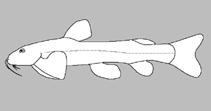
Dorsale stekels (totaal) : 0; Dorsale zachte stralen (totaal) : 8; Anale stekels: 0; Anale zachte stralen: 9 - 10; Wervels: 34 - 37. Diagnosis: Doumea skeltoni is distinguished from all congeners other than D. chappuisi, D. sanaga, and D. thysi in the number of pectoral-fin rays, being 10, rarely 9 or 11, versus 11 to 13 (Ref. 94772). It differs from D. chappuisi in the predorsal length, 38-45% of standard length vs. 32-37%; the body depth at the dorsal-fin origin, 13-16% of standard length vs. 9-13%; and modal value of the number of vertebrae, mode 35 and range 34-37 vs. mode 37 (Ref. 94772). Doumea skeltoni differs from D. sanaga in the predorsal length, 38-45% of standard length vs. 34-37%; the ratio of caudal-peduncle depth to caudal peduncle length, 12-15% vs. 9-11%; the number of vertebrae, 34-37 vs. 38-41; and nearly completely in the head length, 21-26% of standard length vs. 18-21%; and the body depth at the dorsal-fin origin, 13-16% of standard length vs. 10-13% (Ref. 94772). It differs from D. thysi in the caudal-peduncle length, 23-26% of standard length vs. 19-22%; the caudal-peduncle depth, 3-4% of standard length vs. 5-8; the ratio of the caudal-peduncle depth to caudal-peduncle length, 12-15% vs. 25-40%; and the interorbital width, 27-32% of head length vs. 33-38% (Ref. 94772).
Body shape (shape guide): elongated.
Levenscyclus en paargedrag
Maturiteit | Voortplanting | Paaien | Eieren | Fecunditeit | Larven
Ferraris, C.J. and R.P. Vari, 2013. New species of Doumea (Siluriformes: Amphiliidae) from coastal river basins of the Republic of the Congo. Copeia 2013(4):577-581. (Ref. 94772)
Status op de Rode Lijst van het IUCN (Ref. 130435: Version 2025-2 (Global))
Gevaar voor de mens
Harmless
Gebruik door de mens
Tools
Speciale rapporten
Download XML
Internetbronnen
Schattingen op basis van modellen
Fylogenetische diversiteitsindex (Ref.
82804): PD
50 = 0.5020 [Uniqueness, from 0.5 = low to 2.0 = high].
Bayesian length-weight: a=0.00389 (0.00180 - 0.00842), b=3.12 (2.94 - 3.30), in cm total length, based on all LWR estimates for this body shape (Ref.
93245).
Trofisch niveau (Ref.
69278): 3.0 ±0.4 se; based on size and trophs of closest relatives
Weerstandsvermogen (Ref.
120179): Hoog, minimale populatieverdubbelingstijd minder dan 15 maanden (Preliminary K or Fecundity.).
Kwetsbaarheid van de visserij (Ref.
59153): Low vulnerability (10 of 100).
🛈