>
Cichliformes (Cichlids, convict blennies) >
Cichlidae (Cichlids) > Cichlinae
Etymology: Herichthys: Greek, eri = very, a lot + Greek, ichthys = fish (Ref. 45335); pame: The specific name refers to the Pame people, who call themselves xi úi (or their local variants) meaning indigenous. The xi´úi territory includes 5 municipalities in the state of San Luis Potosí: Ciudad del Maíz, Alaquines, Rayón, Santa Catarina, and Tamasopo where the species is endemic.
Eponymy: This is named for the Pame people of México, whose territory includes five municipalities in the state of San Luis Potosí, where this cichlid is found. (Ref. 128868), visit book page.
Entorno: milieu / zona climática / rango de profundidad / gama de distribución
Ecología
; agua dulce bentopelágico; pH range: 7.8 - 8.3. Tropical
Central America: main stem and tributaries of the Rio Gallinas, including Rio Tamasopo, Ojo Frío, and Agua Buena, upriver from the Tamul cascade in Mexico.
Tamaño / Peso / Edad
Madurez: Lm ? range ? - ? cm
Max length : 11.2 cm SL macho / no sexado; (Ref. 94458)
Descripción breve
Claves de identificación | Morfología | Morfometría
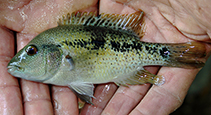
Espinas dorsales (total) : 16 - 17; Radios blandos dorsales (total) : 10 - 11; Espinas anales: 5; Radios blandos anales: 8 - 9. This species can be diagnosed by having the following characters: predorsal contour gradual and acute, not concave before eye; dorsal and ventral contours straight to moderately convex, sloping slowly; intersection with caudal peduncle inconspicuous; and mouth slightly angled downward; ground color khaki when alive; snout, head, and opercles heavily dotted with tiny speckles, extending posteriorly onto nuchal area and base of dorsal fin; eye diameter small (mean 23%, SD 1%), snout long (mean 39%, SD 2%); cheeks shallow (mean 29%, SD 2%) (all in HL); lower pharyngeal plate stout and much broader than long; horns short with lightly pigmented stout molars, 2 central rows of 6-7 molars flank the midline, posterior-most 3 big and stout; and peritoneum uniformly very dark (Ref. 94458).
Body shape (shape guide): fusiform / normal.
Inhabits clear water over a rocky substrate with hardness above 100° dH and pH between 7.8 and 8.3. Sampled together with Herichthys tamasopoensis, H. steindachneri, Xiphophorus montezumae, and Gambusia panuco, among other species of fishes. Based on three specimens examined, stomach contents include detritus (5%), filamentous algae (20%), snails (70%), and unidentified materials (5%) (Ref. 94458).
Ciclo vital y comportamiento de apareamiento
Madurez | Reproducción | Puesta | Huevos | Fecundidad | Larva
de la Maza-Benignos, M. and Ma. De L. Lozano-Villano, 2013. Description of three new species of the genus Herichthys (Perciformes: Cichlidae) from eastern Mexico, with redescription of H. labridens, H. steindachneri, and H. pantostictus. Zootaxa 3734(2):101-129. (Ref. 94458)
Situación en la Lista Roja de la UICN (Ref. 130435: Version 2025-2 (Global))
Amenaza para el ser humano
Harmless
Usos humanos
Herramientas
Informes especiales
Descargar XML
Fuentes de Internet
Estimaciones basadas en modelos
Índice de diversidad filogenética (Referencia
82804): PD
50 = 0.5001 [Uniqueness, from 0.5 = low to 2.0 = high].
Bayesian length-weight: a=0.01445 (0.00665 - 0.03141), b=3.08 (2.90 - 3.26), in cm total length, based on LWR estimates for this (Sub)family-body shape (Ref.
93245).
Nivel trófico (Referencia
69278): 3.3 ±0.1 se; based on size and trophs of closest relatives
Resiliencia (Referencia
120179): Alto, población duplicada en un tiempo mínimo inferior a 15 meses (Preliminary K or Fecundity.).
Vulnerabilidad pesquera (Ref.
59153): Low vulnerability (10 of 100).
🛈