Classification / Noms
Noms communs | Synonymes | Catalog of Fishes(Genre, Espèce) | ITIS | CoL | WoRMS | Cloffa
>
Atheriniformes (Silversides) >
Melanotaeniidae (Rainbowfishes, blue eyes)
Etymology: Melanotaenia: Greek, melan, -anos = black + latin, taenia = stripe (Ref. 45335); urisa: Named with reference to the village name (Urisa) near the type locality.
Environnement : milieu / zone climatique / profondeur / gamme de distribution
Écologie
; eau douce benthopélagique. Tropical
Asia: Indonesia.
Taille / Poids / Âge
Maturité: Lm ? range ? - ? cm
Max length : 8.8 cm SL mâle / non sexé; (Ref. 91054)
Description synthétique
Clés d'identification | Morphologie | Morphométrie
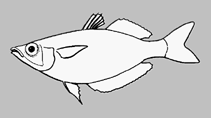
Épines dorsales (Total) : 4 - 5; Rayons mous dorsaux (Total) : 12 - 15; Épines anales: 1; Rayons mous anaux: 21 - 23. Can be diagnosed from all its congeners from Bomberai Peninsula and Bird’s Neck region by the combination of the following characters: dorsal fin with IV to V-I,12 -15 rays; anal fin with I,21-23 rays ; 36-39 lateral scales; 10-11 transverse scales; 18-20 predorsal scales; 13-16 cheek scales; 17-18 gillrakers; head length 23.7-25.2% of standard length; snout length 7.6-8.7% of SL; interorbital width 7.9-8.8% of SL; eye diameter, 8.0-9.0% of SL; body width 10.0-11.2% of SL; predorsal length 50.6-54.5% of SL; prepelvic length 36.3-39.2% of SL; preanal length 47.0-49.1% of SL; caudal peduncle length 16.3-19.0 and depth 8.6-10.0% of SL; pectoral fin length 15.2-17.4% of SL and pelvic fin 11.0-13.7% of SL; anal fin height 6.8-9.9% of SL; spine length on the anal fin 7.1-8.5% of SL; dorsal-fin base length 30.8-35.7% of SL and second dorsal-fin base length 20.4-23.5% of SL (Ref. 91054).
Body shape (shape guide): fusiform / normal.
Occurs in a karst spring, consisting of an artesian resurgence of blue freshwater in a brackish swampy environment with a size and volume varying with the season and with the tidal fluctuation. The bottom of the spring is composed of white sand and limestone boulder with substantial dead tree branches. Syntopic with an unknown species of crayfishes, Cherax sp. (Ref. 91054).
Cycle de vie et comportement reproducteur
Maturité | Reproduction | Frai | Œufs | Fécondité | Larves
Kadarusman, R.K. Hadiaty, G. Segura, G. Setiawibawa, D. Caruso and L. Pouyaud, 2012. Four new species of Rainbowfishes (Melanotaeniidae) from Arguni Bay, West Papua, Indonesia. Cybium 36(2):369-382. (Ref. 91054)
Statut dans la liste rouge de l'IUCN (Ref. 130435: Version 2025-2 (Global))
Menace pour l'homme
Harmless
Utilisations par l'homme
Pêcheries: d'intérêt potentiel; Aquarium: potentiel
Outils
Articles particuliers
Télécharger en XML
Sources Internet
Estimations basées sur des modèles
Indice de diversité phylogénétique (Réf.
82804): PD
50 = 0.5000 [Uniqueness, from 0.5 = low to 2.0 = high].
Bayesian length-weight: a=0.01122 (0.00514 - 0.02450), b=3.04 (2.87 - 3.21), in cm total length, based on all LWR estimates for this body shape (Ref.
93245).
Niveau trophique (Réf.
69278): 2.9 ±0.4 se; based on size and trophs of closest relatives
Résilience (Réf.
120179): Milieu, temps minimum de doublement de population : 1,4 à 4,4 années (Preliminary K or Fecundity.).
Vulnérabilité de la pêche (Ref.
59153): Low vulnerability (10 of 100).
🛈