>
Cyprinodontiformes (Rivulines, killifishes and live bearers) >
Aphaniidae (Oriental killifishes)
Etymology: Esmaeilius: Named for Hamid Reza Esmaeili (Shiraz) for his extensive contribution to the understanding of diversity within this genus; shirini: Named for the stream and village of Khosroshirin, the type locality.
Eponymy: Dr Hamid Reza Esmaeili is an Iranian biologist and ichthyologist at Shiraz University, Shiraz where he is full Professor of Ichthyology. [...] (Ref. 128868), visit book page.
Milieu: milieu / Klimaatzone / Diepte / verspreidingsgebied
Ecologie
; zoet water benthopelagisch. Subtropical
Asia: Khosroshirin Stream in the uppermost reaches of the Kor River Basin and its connected springs including Paselari and Pahn springs in Iran.
Grootte / Gewicht / Leeftijd
Maturiteit: Lm ? range ? - ? cm
Max length : 3.0 cm SL mannelijk / geslacht onbekend; (Ref. 94548); 3.6 cm SL (female)
Korte beschrijving
Determinatiesleutels | Morfologie | Morfometrie
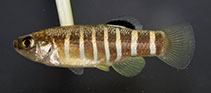
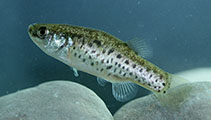
Dorsale zachte stralen (totaal) : 10 - 12; Anale zachte stralen: 10 - 11. This species can be easily diagnosed at the genetic level from all its congeners in Iran by having 17 fixed molecular apomorphies (14 transitions and three transversions) in cytochrome b gene. In addition, it differs from Aphanius sophiae by having 61 fixed molecular apomorphies (46 transitions and 15 transversions). Males are distinguished from all other Iranian species by having only 7-10 wide clearly defined white flank bars, which is the lowest number of white flank bars among the Iranian inland Aphanius species, and bright to yellowish anal fin without clear white margin. Both males and females differ from other Aphanius species in Iran by having a significantly longer caudal peduncle and a smaller dorsal fin depth (measurements relative to the standard length) . The otoliths are diagnostic because they display a distinctive combination of characters such as a straight ventral rim, an angular to rectangular posteroventral edge and a wide but short and truncated rostrum. In addition, dorsal part of this species is longer than in the other examined species (Ref. 94548).
Body shape (shape guide): fusiform / normal.
Inhabits Khosroshirin Stream in the uppermost reaches of the Kor River Basin and its connected springs including Paselari and Pahn springs. Paselari spring is composed of muddy substrate with small gravels, and water surface covered by dense filamentous green algae. The surrounding area is vegetated with reed (Phragmatis sp.), rush (Juncus sp.), shrubs and trees. Water current is high in Khosroshirin stream while low in Paselari and Pahn springs. The following mean values of physico-chemical paramaters of three stations from Paselari spring were recorded: nitrates 1.95 mg l-1, nitrites 0.42 mg l-1, phosphates 0.59 mg l-1, ammonia 0.12 mg l-1, dissolved oxygem (DO) 8.92 mg-1, DO% 122.6, total dissolved solids 191.7 mg-1, conductivity 395 μs cm-1, salinity 0.18 0/00, pH 7.9 and water temperature 17.05°C . Collected together with Acanthobrama persidis, Alburnus mossulensis, Capoeta aculeata, Capoeta saadi (Cyprinidae) and Onchorhynchus mykiss (Salmonidae) from Khosroshirin Stream. Threatened mainly by the carnivorous exotic O. mykiss (Ref. 94548).
Levenscyclus en paargedrag
Maturiteit | Voortplanting | Paaien | Eieren | Fecunditeit | Larven
Gholami, Z., H.R. Esmaeili, D. Erpenbeck and B. Reichenbacher, 2013. Phylogenetic analysis of Aphanius from the endorheic Kor River Basin in the Zagros Mountains, South-western Iran (Teleostei: Cyprinodontiformes: Cyprinodontidae). J. Zool. Sys. Evol. Res. 52(2):130-141. (Ref. 94548)
Status op de Rode Lijst van het IUCN (Ref. 130435: Version 2025-2 (Global))
Gevaar voor de mens
Harmless
Gebruik door de mens
Tools
Speciale rapporten
Download XML
Internetbronnen
Schattingen op basis van modellen
Fylogenetische diversiteitsindex (Ref.
82804): PD
50 = 0.5156 [Uniqueness, from 0.5 = low to 2.0 = high].
Bayesian length-weight: a=0.00977 (0.00589 - 0.01620), b=3.28 (3.14 - 3.42), in cm total length, based on LWR estimates for this species & Genus-body shape (Ref.
93245).
Trofisch niveau (Ref.
69278): 3.0 ±0.4 se; based on size and trophs of closest relatives
Weerstandsvermogen (Ref.
120179): Hoog, minimale populatieverdubbelingstijd minder dan 15 maanden (Preliminary K or Fecundity.).
Kwetsbaarheid van de visserij (Ref.
59153): Low vulnerability (10 of 100).
🛈