>
Perciformes/Cottoidei (Sculpins) >
Liparidae (Snailfishes)
Etymology: Careproctus: Greek, kara = face + Greek, proktos = anus (Ref. 45335); kamikawai: Named for Dan J. Kamikawa of the Northwest Fisheries Science Center.
Eponymy: Daniel Joseph Kamikawa (d: 1961) is a Research Fisheries Biologist for the national Marine Fisheries Service at the Northwest Fisheries Science Center (Oregon) (since 1995). [...] (Ref. 128868), visit book page.
Environnement : milieu / zone climatique / profondeur / gamme de distribution
Écologie
marin benthopélagique; profondeur 468 - 1397 m (Ref. 91047). Tropical
Eastern Central Pacific: USA.
Taille / Poids / Âge
Maturité: Lm ? range ? - ? cm
Max length : 17.5 cm TL (female)
Description synthétique
Clés d'identification | Morphologie | Morphométrie
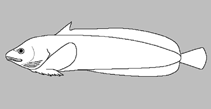
Rayons mous dorsaux (Total) : 43 - 45; Rayons mous anaux: 36 - 38; Vertèbres: 48 - 50. This species is distinguished from its congeners by the following characters: premaxilla and dentary with broad rows of trilobed teeth (vs. simple or weakly trilobed teeth on both jaws); a large gill opening extending ventrally to pectoral rays 8-12 (vs. smaller gill opening above the pectoral fin or extending to less than 5 pectoral-fin rays); large pelvic disk 28.3-32.1% HL (vs. smaller pelvic disk, less than 25% head length) (Ref. 91047).
Body shape (shape guide): elongated; Cross section: compressed.
All specimens examined were females, the largest, a ripe female of 15.3 cm SL (UW 150325). The smallest female with yolked eggs was 13.6 cm SL (UW 119827). At least two sizes of eggs are present in ripe females: yolked eggs 3.5-4.5 mm and white eggs 0.5-1.5 mm in diameter (Ref. 91047).
Cycle de vie et comportement reproducteur
Maturité | Reproduction | Frai | Œufs | Fécondité | Larves
Orr, J.W., 2012. Two new species of snailfishes of the genus Careproctus (Scorpaeniformes: Liparidae) from the Bering Sea and Eastern North Pacific Ocean, with a redescription of Careproctus ovigerus. Copeia 2012(2):257-265. (Ref. 91047)
Statut dans la liste rouge de l'IUCN (Ref. 130435: Version 2025-2 (Global))
Menace pour l'homme
Harmless
Utilisations par l'homme
Pêcheries: sans intérêt
Outils
Articles particuliers
Télécharger en XML
Sources Internet
Estimations basées sur des modèles
Indice de diversité phylogénétique (Réf.
82804): PD
50 = 0.5000 [Uniqueness, from 0.5 = low to 2.0 = high].
Bayesian length-weight: a=0.00447 (0.00203 - 0.00984), b=3.17 (2.99 - 3.35), in cm total length, based on LWR estimates for this Genus-body shape (Ref.
93245).
Niveau trophique (Réf.
69278): 3.3 ±0.5 se; based on size and trophs of closest relatives
Résilience (Réf.
120179): Haut, temps minimum de doublement de population inférieur à 15 mois (Preliminary K or Fecundity.).
Vulnérabilité de la pêche (Ref.
59153): Low vulnerability (10 of 100).
🛈