Classification / Noms
Noms communs | Synonymes | Catalog of Fishes(Genre, Espèce) | ITIS | CoL | WoRMS | Cloffa
>
Gobiesociformes (Clingfishes) >
Gobiesocidae (Clingfishes and singleslits) > Gobiesocinae
Etymology: lombardii: Named for Michael Lombardi, who was part of the diving team; noun in apposition.
Eponymy: Michael Robert Lombardi (d: 1979), was part of the diving team in the Bahamas that collected the type while exploring and documenting the natural history of deep Mesophotic coral reefs. [...] (Ref. 128868), visit book page.
Environnement : milieu / zone climatique / profondeur / gamme de distribution
Écologie
marin récifal. Tropical
Western Atlantic: Bahamas.
Taille / Poids / Âge
Maturité: Lm ? range ? - ? cm
Max length : 1.1 cm SL mâle / non sexé; (Ref. 91048)
Description synthétique
Clés d'identification | Morphologie | Morphométrie
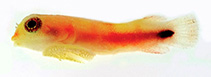
Rayons mous dorsaux (Total) : 8; Rayons mous anaux: 7; Vertèbres: 25. This species is distinguished from its congeners (and all other Bahamian gobiesocids) by the following characters: bright orangish-red coloration, yellow head, a prominent black oval patch on the caudal peduncle; pattern of papillae in disk region C; anteriorly, 2 distinct medial clusters, each comprising 8-9 closely arrayed papillae, and a single papilla anterior of each cluster, are present (vs. 2-5 papillae in each central cluster and 4-5 papillae arranged in a distinct crescent posterolaterally); posteriorly, papillae in disk region C are in a crescent pattern with a single additional papilla dorsal to its midpoint (vs. papillae in an inverted V-shaped pattern in D. nanus, D. altifrons, D. kremnobates; clumped in D. vittager); posterior margin of disk region B in the new species is strongly convex (vs. straight to weakly convex) with the rows of papillae arranged serially in a semi-circular pattern forming concentric crescents (vs. rows more or less straight); possess a total of 47 pectoral-fin rays (Ref. 91048).
Body shape (shape guide): fusiform / normal; Cross section: oval.
Apparently closely associated with deep reefs, not straying far from the safety of a coral head (Ref. 91048).
Cycle de vie et comportement reproducteur
Maturité | Reproduction | Frai | Œufs | Fécondité | Larves
Sparks, J.S. and D.F. Gruber, 2012. A new mesophotic clingfish (Teleostei: Gobiesocidae) from the Bahamas. Copeia 2012(2):251-256. (Ref. 91048)
Statut dans la liste rouge de l'IUCN (Ref. 130435: Version 2025-2 (Global))
Menace pour l'homme
Harmless
Utilisations par l'homme
Outils
Articles particuliers
Télécharger en XML
Sources Internet
Estimations basées sur des modèles
Indice de diversité phylogénétique (Réf.
82804): PD
50 = 0.5312 [Uniqueness, from 0.5 = low to 2.0 = high].
Bayesian length-weight: a=0.01122 (0.00514 - 0.02450), b=3.04 (2.87 - 3.21), in cm total length, based on all LWR estimates for this body shape (Ref.
93245).
Niveau trophique (Réf.
69278): 2.9 ±0.3 se; based on size and trophs of closest relatives
Résilience (Réf.
120179): Haut, temps minimum de doublement de population inférieur à 15 mois (Preliminary K or Fecundity.).
Vulnérabilité de la pêche (Ref.
59153): Low vulnerability (10 of 100).
🛈