>
Cichliformes (Cichlids, convict blennies) >
Cichlidae (Cichlids) > Cichlinae
Etymology: Crenicichla: Latin, crenulatus = cut, clipped + Greek, kichle = wrasse (Ref. 45335); taikyra: The specific name is derived from Guaraní words tãi (tooth) and kyra (thick), in reference to the thick molariform teeth and the stout lower pharyngeal tooth plate of the species.
Môi trường: môi trường / vùng khí hậu / Mức độ sâu / phạm vi phân phối
Sinh thái học
; nước ngọt sống nổi và đáy; pH range: 7.1 - ?. Subtropical; 25°C - ? (Ref. 94256)
South America: middle río Paraná in Argentina.
Bộ gần gũi / Khối lượng (Trọng lượng) / Tuổi
Chín muồi sinh dục: Lm ? range ? - ? cm
Max length : 11.6 cm SL con đực/không giới tính; (Ref. 94256)
Mô tả ngắn gọn
Khóa để định loại | Hình thái học | Sinh trắc học
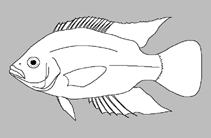
Các tia vây lưng cứng (tổng cộng) : 20 - 22; Các vây lưng mềm (tổng cộng) : 10 - 12; Tia mềm vây hậu môn: 10 - 11; Động vật có xương sống: 35 - 36. Distinguished from all congeners except Crenicichla jurubi, C. semifasciata, and C. yaha by its stout lower pharyngeal tooth plate with molariform teeth (vs. slender pharyngeal tooth plate without molariform teeth). Differs from C. jurubi in having a serrated preopercle (vs. smooth), a well developed suborbital stripe (vs. absent or reduced to a spot at margin of orbit), and lacking scattered dots on back and sides (vs. presence); from C. semifasciata in having an ascending arm of the premaxilla longer (vs. shorter than the dentigerous one), caudal fins subtruncated (vs. deeply rounded), caudal fin scaled only on its basal third (vs. mostly scaled), caudal spot without light ring (vs. caudal spot surrounded by a silvery or orange ring), and a narrower interorbital width (17.1-23.3% vs. 32.0-40.0% of HL); and from C. yaha by having a stouter lower pharyngeal tooth plate with about 16 molariform teeth (vs. about 4 molariform teeth), and absence of microbranchiospines on gill arches (vs. presence).
Differs further from other species inhabiting the rio Parana basin by the following characters: from C. iguassuensis and C. tesay) in having isognathous jaws (vs. lower jaw prognathous); from C. hu in having a color pattern with a gray or olive green background (vs. dark brown to black), and E1 row scales 54-60 (vs. 47-54 ); from C. mandelburgeri in having more scales in E1 row scales (54-60 vs. 44-56), jaws isognathous (vs. lower jaws prognathous), and absence of lateral band in adults (vs. presence); from C. ypo in having isognathous jaws and blotches on flanks placed below the upper lateral line (vs. lower jaw slightly prognathous and the blotches are extending 3 to 4 scale rows above and below lateral line); and from C. haroldo by lacking brown dots on each lateral line scale and lateral band on flanks (vs. present in C. haroldoi). The absence of a lateral band separates C. taikyra from C. jaguarensis. Crenicichla jupiaensis can be diagnosed from C. taikyra in having the suborbital stripe reduced to a few spots posterior to the orbit, a thin black line on the posterior margin of preoperculum, cheek naked, and numerous vertical stripes. Crenicichla lepidota and C. britskii have a humeral spot (vs. absent in C. taikyra). Crenicichla scottii has parallel and thin longitudinal bands and C. gillmorlisi has small dark dots all over the sides, features not present in C. taikyra. Crenicichla vittata has 78-85 in E1 row scales, lateral band, and a particular color pattern on top of the head forming a crown design whereas C. taikyra has 54-60 E1 row scales, absence of lateral band, and the pattern of pigmentation on head described above (Ref. 94256).
Body shape (shape guide): fusiform / normal.
Inhabits stony environment with Secchi disk 212 mm, water temperature 25.1°C, pH 7.14, conductivity 51.4 μS cm-1, dissolved oxygen 99.7% saturation, and alkalinity 9.0 mg l-1.. Stomach contents of two specimens contained snails (Potamolithus sp. and Limnoperna fortunei) and remains of fishes (Ref. 94256).
Vòng đời và hành vi giao phối
Chín muồi sinh dục | Sự tái sinh sản | Đẻ trứng | Các trứng | Sự sinh sản | Ấu trùng
Casciotta, J., Aichino, D. Almirón, S. Gómez, L. Piálek and O. Řičan, 2013. Crenicichla taikyra (Teleostei: Cichlidae), a new species of pike cichlid from the middle río Paraná, Argentina. Zootaxa 3721(4):379-386. (Ref. 94256)
Tình trạng Sách đỏ IUCN (Ref. 130435: Version 2025-2 (Global))
Mối đe dọa đối với con người
Harmless
Sử dụng của con người
Các công cụ
Báo cáo đặc biệt
Tải xuống XML
Các nguồn internet
Ước tính dựa trên mô hình
Chỉ số đa dạng phát sinh loài (Tài liệu tham khảo
82804): PD
50 = 0.5000 [Uniqueness, from 0.5 = low to 2.0 = high].
Bayesian length-weight: a=0.01445 (0.00665 - 0.03141), b=3.08 (2.90 - 3.26), in cm total length, based on LWR estimates for this (Sub)family-body shape (Ref.
93245).
Mức dinh dưỡng (Tài liệu tham khảo
69278): 3.2 ±0.5 se; based on size and trophs of closest relatives
Thích nghi nhanh (Tài liệu tham khảo
120179): Chiêù cao, thời gian nhân đôi của chủng quần tối thiểu là dưới 15 tháng (Preliminary K or Fecundity.).
Sự dễ bị tổn thương của nghề đánh cá (Ref.
59153): Low vulnerability (10 of 100).
🛈