>
Osteoglossiformes (Bony tongues) >
Mormyridae (Elephantfishes)
Etymology: Petrocephalus: Latin, petra = stone + Greek, kephale = head (Ref. 45335); arnegardi: This species is dedicated to Matthew E. Arnegard, in recognition of his contributions to study of mormyrid evolution and diversification; Matthew Arnegard is additionally a member of the “Mintotom Team”: researchers associated with the Carl D. Hopkins Laboratory at Cornell University who have conducted field studies on African weakly electric fishes for more than 15 years ("Mintotom" is the plural form of the word for mormyrid fish in the Fang language of West Central Africa) (Ref. 96601).
Eponymy: Dr Matthew Arnegard (d: 1967) is an evolutionary biologist who was a member of the ‘Mintotom Team’ of researchers in the laboratory of Professor Carl Hopkins, Cornell University (N. [...] (Ref. 128868), visit book page.
Entorno: milieu / zona climática / rango de profundidad / gama de distribución
Ecología
; agua dulce demersal. Tropical
Africa: various tributaries of the Likouala drainage (middle Congo River tributary) in Republic of Congo, and the middle Congo River near Yangambi in Democratic Republic of the Congo (Ref. 96601).
Tamaño / Peso / Edad
Madurez: Lm ? range ? - ? cm
Max length : 9.0 cm macho / no sexado; (Ref. 96601)
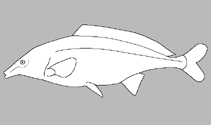
Diagnosis: Petrocephalus arnegardi is distinguished from all other Petrocephalus species of Central Africa by the following combination of characteristics: pigmentation pattern comprising three well-defined, bilateral black patches, one usually distinct round/ovoid subdorsal black mark situated slightly anterior to dorsal, one black mark at the base of each pectoral fin, and one ovoid black mark centered at the base of caudal fin; dorsal fin at least one third shorter than anal fin; dorsal fin with at least 20 branched rays but no more than 22; anal fin with at least 30 branched rays; 16 teeth or fewer in upper jaw, 25 teeth or fewer in lower jaw; eye relatively large, ration head length and eye-diameter less than 4.7; mouth subterminal; ration of head length to mouth position between 4.2 and 5.6; mouth small, ration head length and mouth width more than 4.1; and EOD of normal polarity, mainly biphasic with sometimes the presence of a small-amplitude positive third phase (Ref. 96601).
Body shape (shape guide): fusiform / normal.
Ciclo vital y comportamiento de apareamiento
Madurez | Reproducción | Puesta | Huevos | Fecundidad | Larva
Lavoué, S. and J.P. Sullivan, 2014. Petrocephalus boboto and Petrocephalus arnegardi, two new species of African electric fish (Osteoglossomorpha, Mormyridae) from the Congo River basin. ZooKeys 400:43-65. (Ref. 96601)
Situación en la Lista Roja de la UICN (Ref. 130435: Version 2025-2 (Global))
Amenaza para el ser humano
Harmless
Usos humanos
Herramientas
Informes especiales
Descargar XML
Fuentes de Internet
Estimaciones basadas en modelos
Índice de diversidad filogenética (Referencia
82804): PD
50 = 0.5000 [Uniqueness, from 0.5 = low to 2.0 = high].
Bayesian length-weight: a=0.01549 (0.00672 - 0.03569), b=2.87 (2.69 - 3.05), in cm total length, based on LWR estimates for this Genus-body shape (Ref.
93245).
Nivel trófico (Referencia
69278): 3.2 ±0.4 se; based on size and trophs of closest relatives
Resiliencia (Referencia
120179): Alto, población duplicada en un tiempo mínimo inferior a 15 meses (Preliminary K or Fecundity.).
Vulnerabilidad pesquera (Ref.
59153): Low vulnerability (10 of 100).
🛈