>
Gobiiformes (Gobies) >
Gobiidae (Gobies) > Gobiinae
Etymology: Trimma: Greek, trimma, -atos = something crushed (Ref. 45335); pajama: Name from the Hindi word 'pajama', a loose clothing worn when retiring for the night, alluding to the contrasting stripes so common in at least the British version of that garment; noun in apposition.
Milieu: milieu / Klimaatzone / Diepte / verspreidingsgebied
Ecologie
marien rifbewoner; diepte 3 - 10 m (Ref. 96671). Tropical
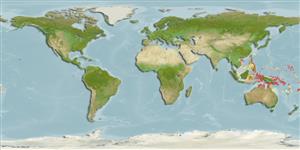
Western Pacific: Indonesia and Papua New Guinea, with photographs and specimens from the Solomon Is. and Palau (Ref. 96671); and Tonga (Ref. 90102).
Grootte / Gewicht / Leeftijd
Maturiteit: Lm ? range ? - ? cm
Max length : 1.6 cm SL (female)
Korte beschrijving
Determinatiesleutels | Morfologie | Morfometrie
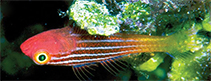
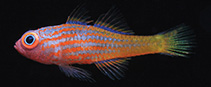
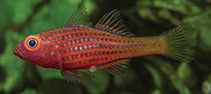
Dorsale stekels (totaal) : 7; Dorsale zachte stralen (totaal) : 8; Anale stekels: 1; Anale zachte stralen: 8. This species is distinguished by the following characters: predorsal midline with 6 scales; 2 ctenoid scales along the upper border of the opercle; cheek scaleless; first 2 dorsal spines slightly elongated and reaching posteriorly to between the base of the spine and the base of the first ray of the second dorsal fin; unbranched pectoral-fin rays; a fifth pelvic fin ray which branches once dichotomously and is 58-72% the length of the fourth ray; full basal membrane connecting the inner margins of the fifth pelvic fins rays in undamaged specimens; live colour pattern of red-orange and dark brown or grey stripes on the body reaching posteriorly to the anterior half of the caudal peduncle, it is unique among members of the genus, as is the preserved colour pattern of dark and light body stripes (Ref. 96671).
Body shape (shape guide): fusiform / normal; Cross section: oval.
This species appears to be restricted to relatively shallow (3-10 m) reef areas protected from wave
exposure. Type specimens were collected exclusively from within beds of Halimeda macroalgae growing beneath branching Acropora coral stands. It is apparently the only species of the genus to be limited to this habitat (Ref. 96671).
Levenscyclus en paargedrag
Maturiteit | Voortplanting | Paaien | Eieren | Fecunditeit | Larven
Winterbottom, R., M.V. Erdmann and N.K.D. Cahyani, 2014. Three new species of Trimma (Pisces; Gobioidei) from Indonesia. Zootaxa 3838(3):367-384. (Ref. 96671)
Status op de Rode Lijst van het IUCN (Ref. 130435: Version 2025-2 (Global))
Gevaar voor de mens
Harmless
Gebruik door de mens
Visserij: van geen belang
Tools
Speciale rapporten
Download XML
Internetbronnen
Schattingen op basis van modellen
Gewenste temperatuur (Ref.
123201): 27.5 - 29.4, mean 28.8 °C (based on 999 cells).
Fylogenetische diversiteitsindex (Ref.
82804): PD
50 = 0.5000 [Uniqueness, from 0.5 = low to 2.0 = high].
Bayesian length-weight: a=0.01023 (0.00477 - 0.02194), b=3.01 (2.83 - 3.19), in cm total length, based on LWR estimates for this (Sub)family-body shape (Ref.
93245).
Weerstandsvermogen (Ref.
120179): Hoog, minimale populatieverdubbelingstijd minder dan 15 maanden (Preliminary K or Fecundity.).
Kwetsbaarheid van de visserij (Ref.
59153): Low vulnerability (10 of 100).
🛈