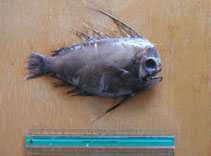
Classification / Noms
Noms communs | Synonymes | Catalog of Fishes(Genre, Espèce) | ITIS | CoL | WoRMS | Cloffa
>
Scombriformes (Mackerels) >
Caristiidae (Manefishes)
Etymology: Platyberyx: Name from the Greek 'platy' meaning flat and Beryx, a genus of beryciform fishes; mauli: Named for G.E. Maul, a well-known ichthyologist from Portugal,.
Eponymy: Günther Edmund Maul (1909–1997) was a German ichthyologist and taxidermist who lived and worked most of his life in Madeira. [...] (Ref. 128868), visit book page.
Environnement : milieu / zone climatique / profondeur / gamme de distribution
Écologie
marin bathypélagique; profondeur ? - 849 m (Ref. 93123). Subtropical
Eastern Atlantic: Madeira to the coastal zone of Morocco, and off Faroe Is.
Taille / Poids / Âge
Maturité: Lm ? range ? - ? cm
Max length : 14.0 cm SL mâle / non sexé; (Ref. 93123)
Description synthétique
Clés d'identification | Morphologie | Morphométrie
Rayons mous dorsaux (Total) : 28; Rayons mous anaux: 17; Vertèbres: 33 - 34. This species is distinguished by the following characters: teeth on jaws not numerous, small, bristle-shaped, and weak (mobile) and these are located in the anterior parts of the jaws in 2 rows, in the posterior parts, in single rows; vomerine teeth bristle-shaped and numerous (approximately 20); palatine teeth bristle-shaped in 2 rows; gill rakers on the first branchial arch short, flattened, fleshy, with weakly developed spinules, total number 16; oral-branchial cavity dark; pelvic fins attached at a level of the vertical through the posterior margin of the pectoral plate and the distinct oval hollow is behind the pelvic fins anteriorly from the abdominal dermal fissure; dorsal fin with 27 rays, its origin at the vertical through the posterior margin of the orbit; head small (ca. 4 times in SL); orbit diameter less than the caudal peduncle depth (Ref. 93123).
Body shape (shape guide): short and / or deep; Cross section: compressed.
Cycle de vie et comportement reproducteur
Maturité | Reproduction | Frai | Œufs | Fécondité | Larves
Stevenson, D.E. and C.P. Kenaley, 2013. Revision of the manefish genera Caristius and Platyberyx (Teleostei: Percomorpha: Caristiidae), with description of five new species. Copeia 2013(3):415-434. (Ref. 94277)
Statut dans la liste rouge de l'IUCN (Ref. 130435: Version 2025-2 (Global))
Menace pour l'homme
Harmless
Utilisations par l'homme
Outils
Articles particuliers
Télécharger en XML
Sources Internet
Estimations basées sur des modèles
Indice de diversité phylogénétique (Réf.
82804): PD
50 = 0.5156 [Uniqueness, from 0.5 = low to 2.0 = high].
Bayesian length-weight: a=0.02455 (0.00947 - 0.06362), b=3.00 (2.77 - 3.23), in cm total length, based on LWR estimates for this (Sub)family-body shape (Ref.
93245).
Niveau trophique (Réf.
69278): 3.5 ±0.5 se; based on size and trophs of closest relatives
Vulnérabilité de la pêche (Ref.
59153): Low vulnerability (10 of 100).
🛈