การจำแนกประเภท / ชื่อ
ชื่อสามัญ | ชื่อพ้อง | Catalog of Fishes(สกุล, ชนิด) | ITIS | CoL | WoRMS | Cloffa
>
Cyprinodontiformes (Rivulines, killifishes and live bearers) >
Procatopodidae (African lampeyes) > Procatopodinae
Etymology: Hylopanchax: Greek, hylo, hyle = material, wood + Panchax, a word created by Meinken in 1932; paucisquamatus: The name is in reference to the low number of lateral line scales, from paucus = few and squamatus = scaled (Ref. 96960).
สิ่งแวดล้อม : สิ่งแวดล้อม / เขตภูมิอากาศ / ระดับความลึก / ระยะการกระจายสินค้า
นิเวศวิทยา
; น้ำจืด ผิวน้ำ. Tropical
Africa: Likouala River drainage (middle Congo River basin) in the Odzala-Kokoua National Park in Republic of Congo (Ref. 96960).
ขนาด / น้ำหนัก / อายุ
วัยเจริญพันธุ์: Lm ? range ? - ? cm
Max length : 2.6 cm SL เพศผู้/กระเทย; (Ref. 96960)
คำอธิบายสั้นๆ
เครื่องมือที่ใช้ในการแยกชนิดสัตว์,สิ่งมีชีวิตออกจากกัน | สัณฐานวิทยา | ความยาวต่างๆ
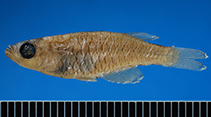
เงี่ยงครีบหลัง (รวม) : 0; ก้านครีบอ่อนที่หาง (รวม) : 9 - 11; เงี่ยงครีบก้น: 0; ก้านครีบอ่อนที่ก้น: 17 - 18; สัตว์มีกระดูกสันหลัง: 29 - 30. Diagnosis: Hylopanchax paucisquamatus is distinguished from all other known Hylopanchax species by a unique combination of morphological characters; by body-shape, it belongs to the group of more deep-bodied species in the genus (Ref. 96960). From the small, very slender H. moke it is distinguished by a deeper body, 26.1-27.2% of standard length vs. 16.3-20.2%; larger size, 22.0-26.1 mm standard length vs. 21.2 mm; a longer head, 26.7-29.6% of standard length vs. 17.9-23.7%; a deeper caudal peduncle, 11.8-12.2% of standard length vs. 7.7-11.3%; a longer dorsal-fin base, 11.7-13.1% of standard length vs. 5.9-9.9%; a lower number of mid-longitudinal scales, 19-21 vs. 23-26; a higher number of dorsal-fin rays, 9-11 vs. 6-7; and insertion of dorsal-fin above anal-fin ray 8 or 9 vs. 11-14 (Ref. 96960). From the slender H. stictopleuron and H. silvestris it is distinguished by a deeper body, 26.1-27.2% of standard length vs. 20.8-21.0% or 22.2-26.3% respectively; a slightly higher number of dorsal-fin rays, 9-11 vs. 6-8; a more anterior origin of dorsal-fin in relation to anal-fin, dorsal above anal-fin ray 8 or 9 vs. 12 or 13; and a lower number of mid-longitudinal scales, 19-21 vs. 24-25 (Ref. 96960). Hylopanchax paucisquamatus is distinguished from the two described deep-bodied species H. leki and H. ndeko by a longer predorsal distance, 68.8-70.7% of standard length vs. 61.0-67.8%; a narrower caudal peduncle and higher caudal peduncle ratio, 11.8-12.2% of standard length and 1.8-1.9 vs. 12.2-15.5% and 1.2-1.7; a shorter dorsal-fin base, 11.7-13.1% of standard length vs. 15.6-22.2%; a lower number of transverse scales, 15-16 vs. 18-22; a slightly lower number of dorsal-fin rays, 9-11 vs. 11-14; and a lower to slightly lower number of mid-longitudinal scales, 19-21 vs. 24-26 for H. ndeko and 21-23 for H. leki (Ref. 96960). It can also be distinguished from H. leki by a less deep body, 26.1-27.2% of standard length vs. 29.2-35.5%; and from H. ndeko by a longer caudal peduncle, 21.8-23.0% of standard length vs. 16.5-20.8% (Ref. 96960).
Body shape (shape guide): fusiform / normal.
วงจรชีวิตและพฤติกรรมการผสมพันธุ์
วัยเจริญพันธุ์ | การสืบพันธุ์ | การวางไข่ | เซลสืบพันธ์ของเพศเมีย(ไข่) | ความดกของไข่ | ตัวอ่อน
Sonnenberg, R., J.P. Friel and J.R. Van der Zee, 2014. Description of Hylopanchax paucisquamatus (Cyprinodontiformes: Poeciliidae), a new lampeye species from the Odzala-Kokoua National Park, Republic of Congo. Zootaxa 3846(4):577-583. (Ref. 96960)
สถานะบัญชีแดงของ IUCN (Ref. 130435: Version 2025-2 (Global))
ภัยคุกคามต่อมนุษย์
Harmless
การใช้ของมนุษย์
เครื่องมือ
รายงานพิเศษ
ดาวน์โหลด XML
แหล่งที่มาจากอินเตอร์เน็ต
การประมาณค่าตามแบบจำลอง
ดัชนีความหลากหลายทางวิวัฒนาการ (อ้างอิง
82804): PD
50 = 0.5039 [Uniqueness, from 0.5 = low to 2.0 = high].
Bayesian length-weight: a=0.00562 (0.00224 - 0.01412), b=3.07 (2.85 - 3.29), in cm total length, based on LWR estimates for this (Sub)family-body shape (Ref.
93245).
ระดับชั้นอาหาร (อ้างอิง
69278): 3.1 ±0.4 se; based on size and trophs of closest relatives
ความเสี่ยงต่อการตกปลา (Ref.
59153): Low vulnerability (10 of 100).
🛈