Classificazione / Nomi
Nomi Comuni | Sinonimi | Catalog of Fishes(Genere, Specie) | ITIS | CoL | WoRMS | Cloffa
>
Cypriniformes (Carps) >
Gastromyzontidae (Hillstream loaches)
Etymology: kalotaenia: Derived from the Greek kalos, meaning beautiful, and taenia, from Greek tainia, meaning stripes or bars, in reference to the blotches on the flank of this species. A noun in apposition.
Ambiente: milieu / zona climatica / distribuzione batimetrica / gamma di distribuzione
Ecologia
; acqua dolce demersale; distribuzione batimetrica 0 - ? m (Ref. 93072). Subtropical
Asia: Liuding and Dishui streams of the Guijiang river drainage (a tributary of Pearl River) in Guangxi, China.
Dimensione / Peso / Età
Maturità: Lm ? range ? - ? cm
Max length : 4.8 cm SL maschio/sesso non determinato; (Ref. 93072)
Breve descrizione
Chiavi di identificazione | Morfologia | Morfometria
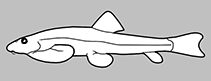
Raggi dorsali molli (totale) : 11; Raggi anali molli: 7. Differs from all congeners by the combination of the following characters: a small median lobe of the rostral fold; lower lip distinctly covered with melanophores; 9-12 squarish blotches on side of body, their height about one-third body depth; and 85-89 lateral line scales. Can be diagnosed from Erromyzon sinensis by having 9-12 irregular blotches on body (vs. 17-21 very irregular bars or a mottled pattern); from
E. compactus by having lower lip with two or three folds (vs. folds absent), a midlateral row of squarish blotches on flank (vs. bars continuous across dorsum), and four rows of blackish spots on dorsal-fin rays, six rows on caudal-fin rays (vs. two rows on both dorsal and caudal-fin rays); and from E. yangi in having 85-89 lateral-line scales (vs. 96-99) and by its color pattern consisting of 9-12 blotches on flank (vs. a black midlateral stripe dark brown dorsum and an incomplete lower black stripe) (Ref. 93072).
Body shape (shape guide): elongated.
Inhabits shallow water at depths of 0.1-0.5 m among boulders and cobbles mixed with sand on the river bed. In Dishui River, other fishes found together with this species include cyprinids (Opsariichthys bidens, Acrossocheilus parallens), balitorids (Pseudogastromyzon fangi, Vanmanenia pingchowensis, Yaoshania pachychilus, Schistura fasciolata) and sisorids (Glyptothorax fokiensis, Pterocryptis anomala). In Liuding River, this species occurs together with Zacco platypus, Puntius semifasciolatus, Pseudorasbora parva, Carassius auratus, Oreonectes platycephalus, Traccatichthys pulcher, Cobitis sinensis and Tachysurus adiposalis (Ref. 93072).
Ciclo vitale e comportamento di accoppiamento
Maturità | Riproduzione | Deposizione | Uova | Fecondità | Larve
Yang, J., M. Kottelat, J.-X. Yang and X.-Y. Chen, 2012. Yaoshania and Erromyzon kalotaenia, a new genus and species of balitorid loaches for Guangxi, China (Teleostei: Cypriniformes). Zootaxa 3586:173-186. (Ref. 93072)
Stato della Lista Rossa IUCN (Ref. 130435: Version 2025-2 (Global))
Minaccia per l'uomo
Harmless
Usi umani
Pesca: di nessun interesse
Strumenti
Rapporti speciali
Scarica XML
Fonti Internet
Stime basate su modelli
Indice di diversità filogenetica (Fonte Biblio.
82804): PD
50 = 0.5625 [Uniqueness, from 0.5 = low to 2.0 = high].
Bayesian length-weight: a=0.00646 (0.00285 - 0.01461), b=3.11 (2.91 - 3.31), in cm total length, based on LWR estimates for this (Sub)family-body shape (Ref.
93245).
Livello trofico (Fonte Biblio.
69278): 2.8 ±0.3 se; based on size and trophs of closest relatives
Vulnerabilità della pesca (Ref.
59153): Low vulnerability (10 of 100).
🛈