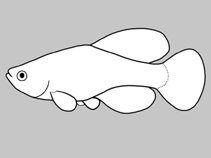
Классификация / Имена
народные названия | синонимы | Catalog of Fishes(род, виды) | ITIS | CoL | WoRMS | Cloffa
>
Cyprinodontiformes (Rivulines, killifishes and live bearers) >
Nothobranchiidae (African rivulines)
Etymology: Nothobranchius: Greek, nothos = false + Greek, brangchia = gill (Ref. 45335); chochamandai: The specific name is given in honour of Professor Auguste Chocha Manda of the University of Lubumbashi, Katanga, Congo DR, for his dedication to research of the ichthyofauna of the Democratic Republic of Congo (Ref. 97353).
Eponymy: Professor Auguste Chocha Manda is an ichthyologist at thge University of Lubumbashi, Katanga, DR Congo. [...] (Ref. 128868), visit book page.
Окружающая среда: среда / климатическая зона / пределы глубины / диапазон распространения
экология
; пресноводный пелагический. Tropical
Africa: only known from Lufutishi River system in middle Luapula River drainage, upper Congo River basin in Democratic Republic of the Congo (Ref. 97353, 117281).
Размер / Вес / Возраст
половая зрелость: Lm ? range ? - ? cm
Max length : 3.5 cm SL самец/пол неопределен; (Ref. 97353)
Краткое описание
определительные ключи | морфология | морфометрия
колючие лучи спинного плавника (общее число) : 0; членистые (мягкие) лучи спинного плавника (общее число) : 15 - 18; колючие лучи анального плавника: 0; членистые (мягкие) лучи анального плавника: 15 - 18. Diagnosis: Nothobranchius chochamandai belongs to the N. brieni species-group, presenting the diagnostic characters of male colouration for this complex of the caudal and anal fins proximal portion spotted; absence of dark distal margin on dorsal fin; absence of spots on head; and absence of black posterior margin of scales (Ref. 97353). Nothobranchius chochamandai is distinguished from all other species of this complex, with the exception of N. symoensi by an anal fin with a light blue distal margin; distinguished from N. symoensi by a dorsal fin without a light blue distal margin, vs. present, and a caudal fin without dark submarginal band, vs. present; within the N. brieni species-group, N. chochamandai is characterised by the following unique combination of morphometrics: postorbital length 56-60% head length; snout length 16-19% head length; head width 65-69% head depth; caudal peduncle length 135-142% caudal depth (Ref. 97353).
Body shape (shape guide): fusiform / normal.
The type locality was a large ephemeral pool formed in a river bed, as a standing fragment of the seasonal river, at the collecting point about 100 m wide, and about 1.5 m deep at its deepest point; all collecting took place in the same general habitat; most parts of the habitat were heavily overgrown by grass and aquatic vegetation consisted of Nymphea species; water slightly turbid, whereas at shallower parts the bottom of the pool was visible; water temperature around noon 25.3°C, pH 7.30 and it contained 20 ppm of total dissolved solids (Ref. 97353).
Жизненный цикл и брачное поведение
половая зрелость | размножение | нерест | икра | Плодовитость | личинки
Nagy, B., 2014. Nothobranchius chochamandai, a new species of annual killifish from the Luapula drainage, Democratic Republic of Congo (Cyprinodontiformes: Nothobranchiidae). Ichthyol. Explor. Freshwat. 25(2):167-183. (Ref. 97353)
Статус Красного Списка МСОП (Ref. 130435: Version 2025-2 (Global))
Угроза для людей
Harmless
Использование человеком
рыболовство: интереса не представляет
дополнительная информация
инструменты
Специальные отчеты
Скачать в формате XML
ресурсы в Интернет
Оценки, основанные на моделях
Индекс филогенетического разнообразия (ссылка
82804): PD
50 = 0.5000 [Uniqueness, from 0.5 = low to 2.0 = high].
Bayesian length-weight: a=0.00603 (0.00250 - 0.01453), b=3.13 (2.93 - 3.33), in cm total length, based on LWR estimates for this (Sub)family-body shape (Ref.
93245).
Трофический уровень (ссылка
69278): 3.2 ±0.4 se; based on size and trophs of closest relatives
Уязвимость рыбной ловли (Ref.
59153): Low vulnerability (10 of 100).
🛈