Elasmobranchi (squali e razze) (sharks and rays) >
Rajiformes (Skates and rays) >
Rajidae (Skates)
Etymology: Rajella: Latin, raja, -ae = a sting ray (Raja sp.) (Ref. 45335); paucispinosa: Name from Llatin 'paucus' for few and 'spinosus' for thorny, referring to the very reduced thorn pattern on the dorsal surface for a Rajella species.
Ambiente: milieu / zona climatica / distribuzione batimetrica / gamma di distribuzione
Ecologia
marino batipelagico; distribuzione batimetrica ? - 1230 m (Ref. 96993). Tropical
Western Indian Ocean off South Mozambique.
Dimensione / Peso / Età
Maturità: Lm ? range ? - ? cm
Max length : 47.1 cm TL maschio/sesso non determinato; (Ref. 96993)
Breve descrizione
Chiavi di identificazione | Morfologia | Morfometria
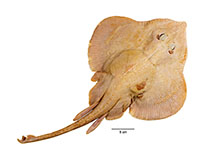
This small species of the genus is distinguished by the following characters: disc is an evenly inverse heart-shaped with broadly rounded outer corners and with body length to mid-vent shorter than tail length from mid-vent; length of preorbital snout 10.9% and distance between first gill slits 14.1% of TL; large orbits with horizontal diameter 1.4 times interorbital width; its dorsal surface is almost completely covered with dermal denticles; the tail with large and coarse, densely set spinules as well as sharp, hooked thornlets that are not much larger than spinules; one small, blunt pre- and postorbital thorn on each side, one small nuchal thorn and one small right scapular thorn (left one not detectable, abraded), and a median row of two small median posterior trunk and 15 small median tail thorns; colour when fresh, dorsal surface plain chalk white including orbits and ventral surface grayish-white; bases of equal-sized and short but high dorsal fins confluent; the postdorsal tail section is very short, with low epichordal caudal lobe which is confluent with second dorsal fin; whitish lateral tail folds along posterior 45% of tail; tooth rows on upper jaw 31; pectoral fin radials 55-56; clasper without external pseudosiphon, the inner dorsal lobe with components slit, terminal bridge, and two clefts and the inner ventral lobe with components shield, rhipidion, pent, sentinel, spike, and dike; terminal clasper skeleton with 4 dorsal terminal cartilages, a terminal bridge, a ventral terminal, and 2 accessory terminal cartilages; anterior cranial fontanelle with clear-cut contour all around and extending about one third into rostral shaft length; subquadratic scapulocoracoid, the rear corner sharply marked, large oval anterior fenestra without anterior bridge, one moderately large, oval postdorsal and postventral fenestra, respectively; pelvic girdle with massive ischiopubic bar with nearly straight anterior and deeply concave posterior contour; prepelvic processes are short, solid, conical, and somewhat inclined outwards, their length 1.9 times median thickness of ischiopubic bar (Ref. 96993).
Cross section: flattened.
Ciclo vitale e comportamento di accoppiamento
Maturità | Riproduzione | Deposizione | Uova | Fecondità | Larve
Weigmann, S., M.F.W. Stehmann and R. Thiel, 2014. Rajella paucispinosa n. sp., a new deep-water skate (Elasmobranchii, Rajidae) from the western Indian Ocean off South Mozambique, and a revised generic diagnosis. Zootaxa 3847(3):359-387. (Ref. 96993)
Stato della Lista Rossa IUCN (Ref. 130435: Version 2025-2 (Global))
Minaccia per l'uomo
Harmless
Usi umani
Strumenti
Rapporti speciali
Scarica XML
Fonti Internet
Stime basate su modelli
Indice di diversità filogenetica (Fonte Biblio.
82804): PD
50 = 0.5000 [Uniqueness, from 0.5 = low to 2.0 = high].
Bayesian length-weight: a=0.00302 (0.00141 - 0.00645), b=3.24 (3.07 - 3.41), in cm total length, based on LWR estimates for this (Sub)family-body shape (Ref.
93245).
Livello trofico (Fonte Biblio.
69278): 3.6 ±0.5 se; based on size and trophs of closest relatives
Resilienza (Fonte Biblio.
120179): Basso, tempo minimo di raddoppiamento della popolazione 4.5 - 14 anni (Preliminary low fecundity).
Vulnerabilità della pesca (Ref.
59153): Moderate vulnerability (37 of 100).
🛈