>
Aulopiformes (Grinners) >
Aulopidae (Aulopus)
Etymology: pyrhistion: Name from Greek words 'pyr' for fire and 'histion' for sail, referring to the colourful red and yellow patterned dorsal fin, which is diagnostic to this species.
characteristic of this species.
Ambiente: milieu / zona climática / intervalo de profundidade / gama de distribuição
Ecologia
marinhas demersal; intervalo de profundidade 80 - 380 m (Ref. 94775). Tropical
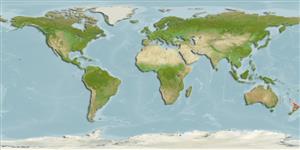
Southwestern Pacific: Northeastern New Zealand, including the Bay of Plenty, and the Kermadec Ridge, the Norfolk Ridge and Lord Howe Rise in the Tasman Sea and off� eastern Australia (between Innisfail, Queensland and Brunswick Heads, New South Wales).
Tamanho / Peso / Idade
Maturidade: Lm ? range ? - ? cm
Max length : 26.8 cm SL macho/indeterminado; (Ref. 94775); 23.4 cm SL (female)
Descrição breve
Chaves de identificação | Morfologia | Morfometria
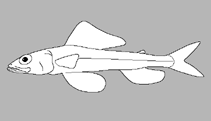
Raios dorsais moles (total) : 15 - 17; Raios anais moles: 10 - 11; Vértebras: 42 - 43. This species is distinguished by the following characters: D 16, rarely 15 or 17; A 10, rarely 9 or 11; pectoral fin rays 11, rarely 10; vertebrae 42-43; total gill rakers 15-20; lateral line scales 41-43; pyloric caeca 11; dorsal fin in males large and sail-like anteriorly with membranes deeply incised but none are filamentous, 3rd-5th rays longest, reaching 36.5% SL, decreasing in length to middle of fin with posterior rays progressively longer, reaching 23.4% SL, posterior lobe reaching to or past origin of adipose fin; dorsal fin in females with anterior end of lower and membranes are deeply incised with rays decreasing in length to middle of fin, lengths of subsequent rays subequal; posterior lobe reaching little more than half way to hypural crease; anal fin of males are relatively deep with posterior lobe approaching hypural crease in large individuals; anal fin in females are smaller with posterior lobe reaching little more than half way to hypural crease; males have subdistal red to orange band or row of spots anteriorly in raised portion of dorsal fin, a row of fainter orange spots behind and below, broad distal margin mostly white, basal half of fin with two rows of large orange-edged yellow spots; anal fin whitish broad yellow stripe on basal half of fin; caudal fin white with broad horizontal stripe from fleshy base on each lobe, lower lobe crossed with about 2 broad yellow bands, upper lobe crossed with 3-4 narrower orange bands, last just below white lobe tip; pelvic fins are whitish with faint yellow to orange bands or rows of spots, especially at base; colour of head and body tan to pink above, white below with 3 brown double bands on dorsal half of side and row of uneven sized dark pink to mauve blotches just below lateral midline; females have several horizontal rows of large reddish or reddish-orange spots in dorsal fin, distal margin white, broadest anteriorly, unpaired fins no yellow markings; caudal, pelvic and sometimes anal crossed with usually faint orange bands, darkest near tip of upper caudal lobe, its head and body similar to that of males and usually with distinct dark brown horizontally aligned double blotch at ventral end of anteriormost band on side (Ref. 94775).
Body shape (shape guide): elongated; Cross section: oval.
Apparently prefers hard to cobble substrate habitats (Ref. 94775).
Ciclo de vida e comportamento de acasalamento
Maturidade | Reprodução | Desova | Ovos | Fecundidade | Larvas
Gomon, M.F., C.D. Struthers and A.L. Stewart, 2013. A new genus and two new species of the family Aulopidae (Aulopiformes), commonly referred to as Aulopus Flagfins, Sergeant Bakers or Threadsails, in Australasian waters. Spec. Div. 18:141-161. (Ref. 94775)
Categoria na Lista Vermelha da IUCN (Ref. 130435: Version 2025-2 (Global))
Ameaça para o homem
Harmless
Utilização humana
Ferramentas
Relatórios especiais
Descarregue XML
Fontes da internet
Estimativas baseadas em modelos
Temperatura preferida (Ref.
123201): 12.8 - 19.3, mean 14.3 °C (based on 19 cells).
Índice de diversidade filogenética (Ref.
82804): PD
50 = 0.5020 [Uniqueness, from 0.5 = low to 2.0 = high].
Bayesian length-weight: a=0.00447 (0.00185 - 0.01077), b=3.13 (2.92 - 3.34), in cm total length, based on LWR estimates for this (Sub)family-body shape (Ref.
93245).
Nível Trófico (Ref.
69278): 4.0 ±0.7 se; based on size and trophs of closest relatives
Vulnerabilidade da pesca (Ref.
59153): Low vulnerability (23 of 100).
🛈