Clasificación / Nombres
Nombres comunes | Sinónimos | Catalog of Fishes(Género, Especie) | ITIS | CoL | WoRMS | Cloffa
>
Siluriformes (Catfishes) >
Loricariidae (Armored catfishes) > Loricariinae
Etymology: Farlowella: Because of W. G. Farlow, from Harvard University (Ref. 45335); yarigui: The specific name is an arbitrary combination of letters in reference to the Parque Nacional Natural Serranía de los Yariguíes, Departamento de Santander, Colombia, in recognition of its conservation efforts in the Eastern Colombian Andes. A noun in apposition.
Eponymy: Dr William Gilson Farlow (1844–1919) was an American physician and botanist who specialised in algae. [...] (Ref. 128868), visit book page.
Entorno: milieu / zona climática / rango de profundidad / gama de distribución
Ecología
; agua dulce bentopelágico. Tropical
South America: Río Topón, middle río Magdalena Basin in Colombia.
Tamaño / Peso / Edad
Madurez: Lm ? range ? - ? cm
Max length : 11.2 cm SL macho / no sexado; (Ref. 94974)
Descripción breve
Claves de identificación | Morfología | Morfometría
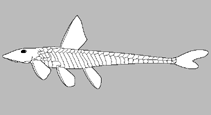
This species belongs to the Farlowella acus species group by the presence of long breeding odontodes on the snout in mature males, four rows of lateral body plates from the anteriormost portion of body to posterior margin of dorsal- and anal-fin base, and two complete rows of ventral plates and no single plate between pelvic-fin insertions. Diagnosed from other members of the F. acus species group by having the median anterior lateral row of plates diamond-shaped (vs. hexagonal in shape in F. acus, F. colombiensis, F. martini, F. venezuelensis and F. vittata). Further differs from F. martini by having dark interradial membranes on the caudal fin (vs. interradial membranes clear in F. martini). Distinguished from members of the Farlowella curtirostra species group by having restricted odontodes on sides of the snout but not extending onto the cheek region (vs. hypertrophied odontodes in breeding males extensive on sides of the snout and cheek); from members of the F. amazona species group by having notably concave lateral margins of the snout (vs. lateral margins of the snout straight to nearly straight) and eyes not elevated on the head (vs. eyes elevated on the head); from species of the Farlowella nattereri species group as well as from Farlowella gracilis by having four rows of lateral plates (vs. five rows in F. gracilis and F. nattereri species group); and from species of the F. knerii and F. mariaelenae species groups by having two abdominal plate rows (vs. three abdominal rows in the F. knerii and F. mariaelenae species groups) (Ref. 94974).
Body shape (shape guide): elongated.
Facultative air-breathing in the genus (Ref. 126274); Found among wood sticks and partially-submerged vegetation using a bottom net. Encountered only in such microhabitat despite collection efforts throughout the main channel of the río Topón. Occurs together with Astyanax caucanus, A. magdalenae, A. filiferus, Roeboides dayi, Sturisoma cf. panamense, Chaetostoma sp., Lasiancistrus caucanus, Creagrutus cf. guanes and Hemibrycon sp. (Ref. 94974).
Ciclo vital y comportamiento de apareamiento
Madurez | Reproducción | Puesta | Huevos | Fecundidad | Larva
Ballen, G.A. and J.I. Mojica, 2014. A new trans-Andean stick catfish of the genus Farlowella Eigenmann & Eigenmann, 1889 (Siluriformes: Loricariidae) with the first record of the genus for the río Magdalena basin in Colombia. Zootaxa 3765(2):134-142. (Ref. 94974)
Situación en la Lista Roja de la UICN (Ref. 130435: Version 2025-2 (Global))
Amenaza para el ser humano
Harmless
Usos humanos
Herramientas
Informes especiales
Descargar XML
Fuentes de Internet
Estimaciones basadas en modelos
Índice de diversidad filogenética (Referencia
82804): PD
50 = 0.5000 [Uniqueness, from 0.5 = low to 2.0 = high].
Bayesian length-weight: a=0.00398 (0.00185 - 0.00857), b=3.11 (2.93 - 3.29), in cm total length, based on LWR estimates for this (Sub)family-body shape (Ref.
93245).
Nivel trófico (Referencia
69278): 2.6 ±0.2 se; based on size and trophs of closest relatives
Resiliencia (Referencia
120179): Alto, población duplicada en un tiempo mínimo inferior a 15 meses (Preliminary K or Fecundity.).
Vulnerabilidad pesquera (Ref.
59153): Low vulnerability (10 of 100).
🛈