Klassifizierung / Names
Namen | Synonyme | Catalog of Fishes(Gattung, Arten) | ITIS | CoL | WoRMS | Cloffa
>
Siluriformes (Catfishes) >
Loricariidae (Armored catfishes) > Hypoptopomatinae
Etymology: Curculionichthys: Derived from the from the Latin 'curculionem' (elongated snout) and from the Greek 'ichthys' (fishes), in reference to the relatively elongated snouts of the fish species included in this genus; paresi: Name refers to the Paresí Indians who speak Paresí, a branch of the Aruak language. The Paresí used to live throughout most of Mato Grosso State including the municipality of Santo Afonso. Paresí Indians were also some of the main guides of Marechal Cândido Rondon, the famous Brazilian pioneer in this region of Brazil at the beginning of the 18th century. A noun in apposition (Ref. 95507).
Eponymy: These binomials commemorate the indigenous Paresi people who used to inhabit much of the Mato Grosso State, Brazil. (Ref. 128868), visit book page.
Umwelt: Milieu / Klimazone / Tiefenbereich / Verbreitungsgebiet
Ökologie
; süßwasser demersal. Tropical
South America: small tributaries of the rio Sepotuba (riacho Águas Claras, riacho Maracaña and riacho São Jorge) in the upper rio Paraguay basin, Brazil.
Größe / Gewicht / Alter
Geschlechtsreife: Lm ? range ? - ? cm
Max length : 2.6 cm SL Männchen/unbestimmt; (Ref. 95507)
Kurzbeschreibung
Bestimmungsschlüssel | Morphologie | Morphometrie
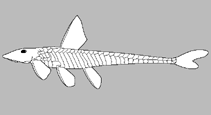
Rückenflossenweichstrahlen (insgesamt) : 9; Afterflossenweichstrahlen: 6; Wirbelzahl: 27. Hisonotus paresi is distinguished from all congeners, except H. bockmanni, by having contrasting dark geometric spots on the anterodorsal region of body (vs. geometric spots absent). It further differs from all congeners, except H. insperatus, H. luteofrenatus, H. oliveirai, H. piracanjuba) by having a pair of rostral plates at the tip of the snout (vs. a single rostral plate). It differs also from all congeners, except H. insperatus, H. luteofrenatus and H. oliveirai by having odontodes forming longitudinally aligned rows on head and trunk (vs. odontodes not forming longitudinally aligned rows). It can be diagnosed from H. bockmanni by having a continuous median series of perforated plate (vs. median plate series of perforated plates discontinuous, that is, with a gap of unperforated plates), by the absence of unpaired plates between the contra-lateral dorsal series (vs. presence of two tiny unpaired plates between the contra-lateral dorsal series, placed eight plates posterior to dorsal fin), and by having the anterior half of the caudal fin darkly pigmented medially (vs. caudal fin with anterior half hyaline); from H. insperatus by having pectoral-fin spine length 27.0?30.1% in SL (vs. 20.6?25.9%); from H. luteofrenatus by having head length 36.1?41.7% SL (vs. 28.8?33.3%), orbital diameter 11.0?14.1% HL (vs. 15.0?18.1%) and snout length 50.7?57.1% HL (vs. 67.0?75.3%); from H. oliveirai by head depth 42.4?47.7% HL (vs. 51.6?59.2%), 6-10 premaxillary teeth (vs. 11?18) and 4-7 dentary teeth (vs. 11?15); from H. piracanjuba by head length 36.1?41.7% SL (vs. 27.9?32.2), caudal peduncle depth 10.2?11.3% SL (vs. 8.3?9.5%), 6-10 premaxillary teeth 6?10 (vs. 14?22) and 4-7 dentary teeth (vs. 12?19) (Ref. 95507).
Body shape (shape guide): elongated.
Lebenszyklus und Paarungsverhalten
Geschlechtsreife | Fortpflanzung | Ablaichen | Eier | Fruchtbarkeit | Larven
Roxo, F., C. Zawadaki and W. Troy, 2014. Description of two new species of Hisonotus Eigenmann & Eigenmann, 1889 (Ostariophysi, Loricariidae) from the rio Paraná-Paraguay basin, Brazil. Zookeys 395:57-78. (Ref. 95507)
IUCN Rote Liste Status (Ref. 130435: Version 2025-2 (Global))
Bedrohung für Menschen
Harmless
Nutzung durch Menschen
Fischereien: nicht kommerziell
Tools
Zusatzinformationen
Download XML
Internet Quellen
Schätzungen auf der Grundlage von Modellen
Phylogenetischer Diversitätsindex (Ref.
82804): PD
50 = 0.5001 [Uniqueness, from 0.5 = low to 2.0 = high].
Bayesian length-weight: a=0.00977 (0.00434 - 0.02202), b=3.06 (2.87 - 3.25), in cm total length, based on LWR estimates for this (Sub)family-body shape (Ref.
93245).
Trophische Ebene (Ref.
69278): 2.6 ±0.1 se; based on size and trophs of closest relatives
Widerstandsfähigkeit (Ref.
120179): hoch, Verdopplung der Population dauert weniger als 15 Monate. (Preliminary K or Fecundity.).
Anfälligkeit der Fischerei (Ref.
59153): Low vulnerability (10 of 100).
🛈