Classificazione / Nomi
Nomi Comuni | Sinonimi | Catalog of Fishes(Genere, Specie) | ITIS | CoL | WoRMS | Cloffa
>
Siluriformes (Catfishes) >
Loricariidae (Armored catfishes) > Hypostominae
Etymology: Pseudancistrus: Greek, pseudes = false + Greek, agkistron = hook (Ref. 45335); zawadzkii: Named for Cláudio Henrique Zawadzki, professor at Universidade Estadual de Maringá (UEM), Maringá, Paraná State, Brazil, in recognition of his dedication and remarkable contributions to the study of the family Loricariidae.
Eponymy: Dr Cláudio Henrique Zawadzki is a zoologist, limnologist and ichthyologist who is Associate Professor of Zoology at Universidade Estadual de Maringá, Paraná, Brazil, where he also was awarded his bachelor’s degree (1993), his master’s (1996) and his [...] (Ref. 128868), visit book page.
Ambiente: milieu / zona climatica / distribuzione batimetrica / gamma di distribuzione
Ecologia
; acqua dolce demersale. Tropical
South America: Rio Tapajós and rio Tracuá of the rio Tapajós basin in Brazil.
Dimensione / Peso / Età
Maturità: Lm ? range ? - ? cm
Max length : 11.6 cm SL maschio/sesso non determinato; (Ref. 95679); 12.9 cm SL (female)
Breve descrizione
Chiavi di identificazione | Morfologia | Morfometria
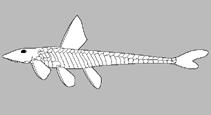
Spine dorsali (totale) : 2; Raggi dorsali molli (totale) : 7; Spine anali: 1; Raggi anali molli: 5. Pseudancistrus zawadzkii can be distinguished from all known congeners, except members of the P. barbatus group, by the possession of hypertrophied odontodes along the snout margin and the absence of evertible cheek plates. It further differs from other congeners by the combination of the following characters: whitish spots that abruptly increase in size between the head (diameter 1.1-1.3 mm) and body (diameter 2.6-3.0 mm); odontodes along margin of snout increasing gradually in length from posterior of snout tip to cheek; longest odontodes on posterior most portion of non-evertible cheek plates.; rounded spots that do not cover more than one plate along the body; head depth 67.0-72.7% of HL; cleithral width 35.2-38.0% of SL; distance between posteromedial margin of supraoccipital and dorsal-fin origin 6.7-9.2% of SL; anal-fin spine length 11.9-13.8% of SL; peduncle depth 12.5-14.2% of SL; and internares distance 12.7-16.6% of HL (Ref. 95679).
Body shape (shape guide): elongated.
Facultative air-breathing in the genus (Ref. 126274); Inhabits clear water rivers, varying from medium to large size, with rocky outcrops forming
small waterfalls and substrates of rocks and sand (Ref. 95679).
Ciclo vitale e comportamento di accoppiamento
Maturità | Riproduzione | Deposizione | Uova | Fecondità | Larve
Da Costa E Silva, G. de S., F.F. Roxo, R. Britzke and C. Oliveira, 2014. New species of the Pseudacistrus barbatus group (Siluriformes, Loricariidae) with comments on its biogeography and dispersal routes. ZooKeys 406:1-23. (Ref. 95679)
Stato della Lista Rossa IUCN (Ref. 130435: Version 2025-2 (Global))
Minaccia per l'uomo
Harmless
Usi umani
Strumenti
Rapporti speciali
Scarica XML
Fonti Internet
Stime basate su modelli
Indice di diversità filogenetica (Fonte Biblio.
82804): PD
50 = 0.5000 [Uniqueness, from 0.5 = low to 2.0 = high].
Bayesian length-weight: a=0.01549 (0.00726 - 0.03306), b=2.96 (2.79 - 3.13), in cm total length, based on LWR estimates for this (Sub)family-body shape (Ref.
93245).
Resilienza (Fonte Biblio.
120179): Medio, tempo minimo di raddoppiamento della popolazione 1.4 - 4.4 anni (Preliminary K or Fecundity.).
Vulnerabilità della pesca (Ref.
59153): Low vulnerability (10 of 100).
🛈