Classification / Noms
Noms communs | Synonymes | Catalog of Fishes(Genre, Espèce) | ITIS | CoL | WoRMS | Cloffa
>
Gobiiformes (Gobies) >
Gobiidae (Gobies) > Sicydiinae
Etymology: Stiphodon: Greek, stiphos, -eos, -oys = mass + Greek, odous = teeth (Ref. 45335); niraikanaiensis: Named after the okinawan mythical place, Niraikanai, and Latin suffix ensis.
Environnement : milieu / zone climatique / profondeur / gamme de distribution
Écologie
; eau douce benthopélagique; amphidrome; profondeur ? - 1 m (Ref. 95104). Subtropical
Northwestern Pacific: Japan.
Taille / Poids / Âge
Maturité: Lm ? range ? - ? cm
Max length : 3.7 cm SL mâle / non sexé; (Ref. 104909); 3.6 cm SL (female)
Description synthétique
Clés d'identification | Morphologie | Morphométrie
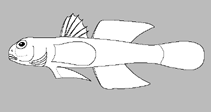
Épines dorsales (Total) : 7; Rayons mous dorsaux (Total) : 9; Épines anales: 1; Rayons mous anaux: 10. This species is distinguished by the following set of characters: D2 9, first dorsal fin pointed with elongate fourth spine in male; pectoral-fin rays 16; premaxilla 46-50 tricuspid teeth; dentary 4 (male) or 1 (female) symphyseal teeth and 40-46 unicuspid horizontal teeth in 2.7-3.6 cm SL; scales in longitudinal row 30-32; nape and posterior half of occipital region with cycloid scales; males without white patch behind pectoral-fin base and a broad black band along distal margin of second dorsal fin, the lateral side of body and dorsal and caudal fins often tinged with vivid orange; females with 11 or 12 dusky transverse bars laterally on trunk and tail, intersecting with the mid-lateral longitudinal band and has several conspicuous black spots on each of the spines and soft rays on the first and second dorsal, and caudal fins; anal fin lacking remarkable marking; pectoral-fin rays with 2-5 and 1-4 black spots, respectively, for male and female (Ref. 95104).
Body shape (shape guide): elongated; Cross section: oval.
The species was observed in a small pool less than 1 m deep and a rapid just below the pool, located 1.5 km from the stream mouth, no major barrier to upstream migration between the stream mouth and this site. The individuals were often shoaled with the abundant S. percnopterygionus and observed scratching on the rock surface for feeding with them. Single individuals of S. atropurpureus and S. multisquamus were also observed at the same site. Other abundant fishes found on the site were amphidromous gobies, such as Sicyopterus japonicus (Tanaka 1909), Awaous melanocephalus (Bleeker 1849), Rhinogobius nagoyae Jordan and Seale 1906, and Tridentiger kuroiwae Jordan and Tanaka 1927, amphidromous pipefish, Microphis leiaspis (Bleeker 1854), and catadromous flagtail, Kuhlia marginata (Cuvier 1829) (Ref. 95104).
Cycle de vie et comportement reproducteur
Maturité | Reproduction | Frai | Œufs | Fécondité | Larves
Maeda, K., 2014. Stiphodon niraikanaiensis, a new species of sicydiine goby from Okinawa Island (Gobiidae: Sicydiinae). Ichthyol. Res.61(2):99-107. (Ref. 95104)
Statut dans la liste rouge de l'IUCN (Ref. 130435: Version 2025-2 (Global))
Menace pour l'homme
Harmless
Utilisations par l'homme
Pêcheries: sans intérêt
Outils
Articles particuliers
Télécharger en XML
Sources Internet
Estimations basées sur des modèles
Indice de diversité phylogénétique (Réf.
82804): PD
50 = 0.5000 [Uniqueness, from 0.5 = low to 2.0 = high].
Bayesian length-weight: a=0.00389 (0.00180 - 0.00842), b=3.12 (2.94 - 3.30), in cm total length, based on all LWR estimates for this body shape (Ref.
93245).
Résilience (Réf.
120179): Haut, temps minimum de doublement de population inférieur à 15 mois (Preliminary K or Fecundity.).
Vulnérabilité de la pêche (Ref.
59153): Low vulnerability (10 of 100).
🛈