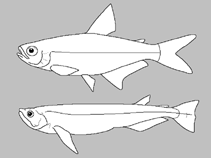
Classificatie / Namen
Lokale namen | Synoniemen | Catalog of Fishes(Genus, Soort(en)) | ITIS | CoL | WoRMS | Cloffa
>
Characiformes (Characins) >
Characidae (Characins; tetras) > Cheirodontinae
Etymology: Serrapinnus: Latin, serran, serranus, saw and a fish of genus Serranus + Latin, pinna = spiny, thorn (Ref. 45335); potiguar: The name refers to 'potiguar', a term traditionally used in Brazil to refer to someone born in the Rio Grande do Norte State. An adjective.
Milieu: milieu / Klimaatzone / Diepte / verspreidingsgebied
Ecologie
; zoet water benthopelagisch. Tropical
South America: Rio Ceará-Mirim basin, Rio Grande do Norte State, Brazil.
Grootte / Gewicht / Leeftijd
Maturiteit: Lm ? range ? - ? cm
Max length : 3.2 cm SL mannelijk / geslacht onbekend; (Ref. 96867)
Korte beschrijving
Determinatiesleutels | Morfologie | Morfometrie
Dorsale zachte stralen (totaal) : 11. Serrapinnus potiguar can be diagnosed from all congeners by the shape and arrangement of the ventral procurrent caudal-fin rays of mature males, where the hypertrophied elements are scimitar-shaped and arranged in a semi-circle through the ventral profile of the caudal peduncle (vs. hypertrophied elements rod-shaped or pointed distally, arranged parallel to each other). It differs further by having 5 cusps in the premaxillary and dentary teeth (vs. 7 to 9 in S. calliurus, S. micropterus, and S. piaba, 9 to 11 in S. sterbai, and 10 to 12 in S. gracilis and S. littoris), terminal mouth (vs. slightly superior mouth in S. microdon), an incomplete lateral line (vs. complete lateral line in S. heterodon), dorsal fin mostly hyaline (vs. dorsal fin with an anterior and proximal dark blotch in S. notomelas), and by lacking black spot in the posteroventral region of the abdomen (vs. present in S. kriegi) (Ref. 96867).
Body shape (shape guide): elongated.
The type locality, the rio Ceará-Mirim, is characterized by clear and transparent water, sandy
bottom high depth 1.2 m, slow to moderate water current and dense floating and submerse vegetation. Sympatric and synotopic with Compsura heterura, Serrapinnus heterodon and S. piaba in the type locality. Feeds mainly on vegetal matter and algae, but also takes insects and microcrustaceans (Ref. 96867).
Levenscyclus en paargedrag
Maturiteit | Voortplanting | Paaien | Eieren | Fecunditeit | Larven
Jerep, F.C. and L.R. Malabarba, 2014. A new species of Serrapinnus Malabarba, 1998 (Characidae: Cheirodontinae) from Rio Grande do Norte State, northeastern Brazil. Neotrop. Ichthyol. 12(2):301-308. (Ref. 96867)
Status op de Rode Lijst van het IUCN (Ref. 130435: Version 2025-2 (Global))
Gevaar voor de mens
Harmless
Gebruik door de mens
Visserij: van geen belang
Tools
Speciale rapporten
Download XML
Internetbronnen
Schattingen op basis van modellen
Fylogenetische diversiteitsindex (Ref.
82804): PD
50 = 0.5000 [Uniqueness, from 0.5 = low to 2.0 = high].
Bayesian length-weight: a=0.01072 (0.00446 - 0.02572), b=3.07 (2.88 - 3.26), in cm total length, based on LWR estimates for this Genus-body shape (Ref.
93245).
Trofisch niveau (Ref.
69278): 2.6 ±0.5 se; based on size and trophs of closest relatives
Kwetsbaarheid van de visserij (Ref.
59153): Low vulnerability (10 of 100).
🛈