klasifikasi / Nama
Nama-nama umum | Sinonim (persamaan) | Catalog of Fishes(Marga, Jenis) | ITIS | CoL | WoRMS | Cloffa
>
Characiformes (Characins) >
Curimatidae (Toothless characins)
Etymology: Cyphocharax: Greek, kyphos = curved, humpback + Greek, charax = a marine fish without identification (Ref. 45335); sanctigabrielis: The specific name is in reference to the município de São Gabriel da Cachoeira, Amazonas State, within which the new species was discovered.
Lingkungan: lingkungan / zona iklim / kisaran kedalaman / jangkauan distribusi
Ekologi
; air tawar bentopelagis. Tropical
South America: Upper rio Negro, Amazon basin in Brazil.
Ukuran / Berat / umur
Kematangan: Lm ? range ? - ? cm
Max length : 6.7 cm SL jantan/; (Ref. 96871)
deskripsi pendek
Kunci identifiaksi (pengenalan) | Morfologi | Morfometrik
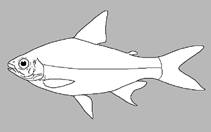
duri punggung lunak (Keseluruhan (total)) : 12; Sirip dubur lunak: 9 - 10; vertebrata, bertulang belakang: 30 - 31. Cyphocharax sanctigabrielis is distinguished from all congeners by having on the lateral surface of the caudal peduncle a distinct, longitudinally elongate, posteriorly often vertically expanded, darkly pigmented mark extending anteriorly from the base of the median caudal-fin rays to the vertical through the posterior limit of the base of the adipose fin. This dark pigmentation on the caudal peduncle is not present in C. abramoides, C. aspilos, C. derhami, C. festivus, C. leucostictus, C. magdalenae, C. microcephalus, C. multilineatus, C. nigripinnis, C. notatus, C. pinnilepis, C. plumbeus, C. stilbolepis, and C. vexillapinnus. When present, the dark pigmentation in that region in other congeners can alternatively be rotund (C. gangamon, C. gillii, C. gouldingi, C. helleri, C. mestomyllon, C. oenas, C. punctatus, C. spiluropsis, and C. vanderi), somewhat triangular with its posterior border darker (C. meniscaprorus), a vertically oriented ellipsoid (C. aninha), in the form of an elongate stripe (C. laticlavius, C. modestus, C. nagelii and C. pantostictus) or longitudinally ovoid but terminating anteriorly distinctly posterior to the vertical through the posterior limit of the base of the adipose fin (C. biocellatus, C. gilbert, C. saladensis, C. santacatarinae, C. signatus, C. spilotus, C. spilurus, and C. voga). It differs further from other congeners by the lack of a series of dark stripes or spots running between the scale rows (vs. the presence of such dark pigmentation in C. helleri, C. multilineatus, and C. pantostictus), the absence of two to eight dark spots distributed along the midlateral surface of the body (vs. the presence of such pigmentation in C. biocellatus, C. punctatus, and C. vanderi), the absence of a patch of dark pigmentation on the dorsal or adipose fins (vs. the presence of such pigmentation in C. nigripinnis, C. notatus and C. vexillapinnus) and a non-fleshy upper lip (vs. lip very fleshy in C. mestomyllon). It can be further diagnosed meristically from various other congeners by having 31 pored scales along the lateral line from the supracleithrum to the hypural joint (vs. 4-9 pored scales in C. aninha, C. saladensis and C. signatus, 27 in C. vanderi, 27 or 28 in C. gangamon and in sum 32 to 97 in C. abramoides, C. aspilos, C. gilbert, C. leucostictus, C. magdalenae, C. nagelii, C. nigripinnis, C. pinnilepis, C. platanus, C. santacatarinae, C. stilbolepis, and C. voga), 9 branched dorsal-fin rays (vs. 10 to 12 in C. spilotus), and 30 or 31 vertebrae (vs. 28 or 29 in C. vanderi and 32 to 37 in C. abramoides, C. aspilos, C. gilbert, C. modestus, C. nagelii, C. notatus, C. platanus, C. santacatarinae, C. stilbolepis, and C. voga). It can be further distinguished from various congeners based on morphometric ratios and counts (Ref. 96871).
Body shape (shape guide): fusiform / normal.
The type locality is a shallow (30-50 cm), slow-flowing stream over fine and sand substrate
within a well-preserved forested setting with the stream borders lined with grasses and rushes (Ref. 96871).
Siklus hidup dan perilaku kawin
Kematangan | Reproduksi, perkembang biakan | Pemijahan | telur-telur | Fekunditas | Larva
Melo, B.F. and R.P. Vari, 2014. New species of Cyphocharax (Characiformes: Curimatidae) from the upper rio Negro, Amazon basin. Neotrop. Ichthyol. 12(2):327-332. (Ref. 96871)
Status IUCN Red List (Ref. 130435: Version 2025-2 (Global))
ancaman kepada manusia
Harmless
penggunaan manusia
Perikanan: tidak ada kepentingan
Alat, peralatan
laporan khas
muat turun XML
Sumber internet
Estimasi berdasarkan model
Indeks keanekaragaman filogenetik (Acuan
82804): PD
50 = 0.5000 [Uniqueness, from 0.5 = low to 2.0 = high].
Bayesian length-weight: a=0.01445 (0.00642 - 0.03257), b=3.02 (2.84 - 3.20), in cm total length, based on LWR estimates for this Genus-body shape (Ref.
93245).
Daya lenting (Acuan
120179): Tinggi, Waktu penggandaan populasi minimum kurang dari 15 bulan (Preliminary K or Fecundity.).
Kerentanan Penangkapan Ikan (Ref.
59153): Low vulnerability (10 of 100).
🛈