Elasmobranchii (haaien en roggen) (sharks and rays) >
Carcharhiniformes (Ground sharks) >
Atelomycteridae (Coloured catsharks)
Etymology: Atelomycterus: ateles (Gr.), imperfect, unfilled or exempt; mycteros (Gr.), nostril, referring to lack of posterior nasal valve (See ETYFish); erdmanni: In honor of marine biologist Mark V. Erdmann (b. 1968), who discovered and collected the type specimens (See ETYFish).
Eponymy: Dr Mark van Nydeck Erdmann (d: 1968) is an American reef fish expert and marine senior advisor with Conservation International Indonesia. [...] (Ref. 128868), visit book page.
Milieu: milieu / Klimaatzone / Diepte / verspreidingsgebied
Ecologie
marien rifbewoner; diepte 3 - 62 m (Ref. 100516). Tropical
Western Pacific: Indonesia.
Grootte / Gewicht / Leeftijd
Maturiteit: Lm ? range ? - ? cm
Max length : 50.1 cm TL mannelijk / geslacht onbekend; (Ref. 100516); 50.8 cm TL (female)
Korte beschrijving
Determinatiesleutels | Morfologie | Morfometrie
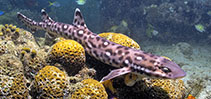
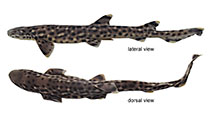
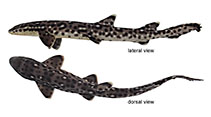
This medium-sized species (to at least 508 mm TL) is distinguished by the following set of characters: relatively short snout, 3.4-3.8% TL; head length 17.5-17.9% TL; precaudal length 76.6-79.1% TL; interdorsal space 13.4-13.7% TL; the distance between pectoral and pelvic fins and pelvic to anal fins about equal, ratio of pectoral-pelvic and pelvic-anal 1.01-1.02; anal-fin length to anal-fin base ratio 1.29; moderately falcate dorsal fins with posterior margins sloping anteroventrally from fin apices; strongly tricuspid denticles with an elongate medial cusp; claspers of adult males are relatively short, the outer length 9% TL, clasper base width 15.5% of clasper outer length, not stubby, not tapering from base to tip; clasper glans extend about half of clasper outer length; cover rhipidion is relatively narrow; rhipidion moderately large, partly concealed by cover rhipidion and exorhipidion; pseudosiphon about half length of cover rhipidion; the clasper tip is narrow and bluntly pointed; colour pattern with dark brown to black and white spots and blotches, and faint dark brown saddles; white spots are surrounded by 2-4 dark spots; dark spots are scattered along most of the ventral surface (less distinct in male); a distinct white stripe run through upper third of gill slits (Ref. 100516).
Body shape (shape guide): elongated; Cross section: oval.
Observed by dive operators in North Sulawesi and Ambon on night dives at depths of 3 to 15 m (Ref. 100516).
Levenscyclus en paargedrag
Maturiteit | Voortplanting | Paaien | Eieren | Fecunditeit | Larven
Fahmi and W.T. White, 2015. Atelomycterus erdmanni, a new species of catshark (Scyliorhinidae: Carcharhiniformes) from Indonesia. J. Ocean Sci. Found. 14:14-27. (Ref. 100516)
Status op de Rode Lijst van het IUCN (Ref. 130435: Version 2025-2 (Global))
Gevaar voor de mens
Harmless
Gebruik door de mens
Tools
Speciale rapporten
Download XML
Internetbronnen
Schattingen op basis van modellen
Fylogenetische diversiteitsindex (Ref.
82804): PD
50 = 0.5157 [Uniqueness, from 0.5 = low to 2.0 = high].
Bayesian length-weight: a=0.00389 (0.00180 - 0.00842), b=3.12 (2.94 - 3.30), in cm total length, based on all LWR estimates for this body shape (Ref.
93245).
Trofisch niveau (Ref.
69278): 3.7 ±0.3 se; based on size and trophs of closest relatives
Weerstandsvermogen (Ref.
120179): laag, minimale populatieverdubbelingstijd 4,5-14 jaar (Preliminary low fecundity).
Kwetsbaarheid van de visserij (Ref.
59153): Moderate vulnerability (40 of 100).
🛈