Klassifizierung / Names
Namen | Synonyme | Catalog of Fishes(Gattung, Arten) | ITIS | CoL | WoRMS | Cloffa
>
Acanthuriformes (Surgeonfishes) >
Siganidae (Rabbitfishes)
Etymology: Siganus: Latin, siganus = a fish, rabbit fish; by the similarity of the nose (Ref. 45335); insomnis: Name from Latin 'insomnis' meaning sleep-less; referring to the nocturnal activity of this fish. It is an adjective agreeing in gender with Siganus (masculine).
Umwelt: Milieu / Klimazone / Tiefenbereich / Verbreitungsgebiet
Ökologie
seewasser riff-verbunden. Tropical
Indian Ocean: southern India, Sri lanka and the Maldives.
Größe / Gewicht / Alter
Geschlechtsreife: Lm ? range ? - ? cm
Max length : 35.0 cm SL Männchen/unbestimmt; (Ref. 95994)
Kurzbeschreibung
Bestimmungsschlüssel | Morphologie | Morphometrie
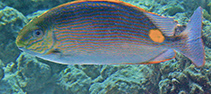
Rückenflossenstacheln (insgesamt) : 8; Rückenflossenweichstrahlen (insgesamt) : 10; Afterflossenstacheln: 7; Afterflossenweichstrahlen: 9. This deep-bodied species is distinguished from other siganids in that the whole of the sides of the body with the possible exception of the belly and a narrow strip adjacent to the base of the spinous dorsal fin (where a row of bronze spots may occur), are decorated with horizontal, parallel bronze bands extending the full length of the sides from nape and opercular slit back to and below the large yellow spot below the base of the soft dorsal fin; majority of these lines on the sides are complete (uninterrupted) along their length (Ref. 95994).
Body shape (shape guide): short and / or deep; Cross section: compressed.
Adults live in schools, usually in coral and sandstone reefs and also seagrass beds; juveniles reportedly live in large estuaries such as Negombo Lagoon (5 km x 3 km). Apparently, estuaries are an important habitat for juveniles and sub-adults, with older fish moving to coral reefs. Feeds by scraping algae from rock and coral substrates and browsing on seaweeds and sea grasses. It supplements its diet with small items of animal tissue. A report on analysis of gut contents of specimens (2 - 27 cm SL), collected by trap and seine, from lagoons and coastal areas of Sri Lanka contain diatoms, green, blue-green, red and brown algae and a seagrass. It appeared that this species have a preference for feeding during the night when percentages of gut fullness between day and night catches were compared. It appeared to be nocturnal because it was mostly seen to be inactive during the day (Ref. 95994).
Lebenszyklus und Paarungsverhalten
Geschlechtsreife | Fortpflanzung | Ablaichen | Eier | Fruchtbarkeit | Larven
Woodland, D.J. and R.C. Anderson, 2014. Description of a new species of rabbitfish (Perciformes: Siganidae) from southern India, Sri Lanka and the Maldives. Zootaxa 3811(1):129-136. (Ref. 95994)
IUCN Rote Liste Status (Ref. 130435: Version 2025-2 (Global))
Bedrohung für Menschen
Harmless
Nutzung durch Menschen
Tools
Zusatzinformationen
Download XML
Internet Quellen
Schätzungen auf der Grundlage von Modellen
Phylogenetischer Diversitätsindex (Ref.
82804): PD
50 = 0.5000 [Uniqueness, from 0.5 = low to 2.0 = high].
Bayesian length-weight: a=0.01413 (0.00635 - 0.03140), b=3.05 (2.87 - 3.23), in cm total length, based on LWR estimates for this Genus-body shape (Ref.
93245).
Widerstandsfähigkeit (Ref.
120179): hoch, Verdopplung der Population dauert weniger als 15 Monate. (Preliminary K or Fecundity.).
Anfälligkeit der Fischerei (Ref.
59153): Low to moderate vulnerability (33 of 100).
🛈