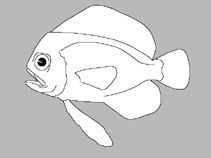
การจำแนกประเภท / ชื่อ
ชื่อสามัญ | ชื่อพ้อง | Catalog of Fishes(สกุล, ชนิด) | ITIS | CoL | WoRMS | Cloffa
>
Scombriformes (Mackerels) >
Caristiidae (Manefishes)
Etymology: Platyberyx: Name from the Greek 'platy' meaning flat and Beryx, a genus of beryciform fishes; rhyton: Name from an ancient Greek word which means a widemouth container for fluids, referring to the relatively large mouth of this species.
สิ่งแวดล้อม : สิ่งแวดล้อม / เขตภูมิอากาศ / ระดับความลึก / ระยะการกระจายสินค้า
นิเวศวิทยา
เกี่ยวกับทะเล,น้ำเค็ม สัตว์ผิวน้ำในเขตน้ำลึก; ระดับความลึก ? - 677 m (Ref. 94277). Subtropical
Northwest Pacific, Japan, off Honshu Island.
ขนาด / น้ำหนัก / อายุ
วัยเจริญพันธุ์: Lm ? range ? - ? cm
Max length : 14.6 cm SL (female)
คำอธิบายสั้นๆ
เครื่องมือที่ใช้ในการแยกชนิดสัตว์,สิ่งมีชีวิตออกจากกัน | สัณฐานวิทยา | ความยาวต่างๆ
ก้านครีบอ่อนที่หาง (รวม) : 30; ก้านครีบอ่อนที่ก้น: 18; สัตว์มีกระดูกสันหลัง: 34. This species is distinguished from P. paucus by having a greater number of dorsal-fin rays (30 vs. 24-26), anal-fin rays (18 vs. 15-16), pectoral-fin rays (18 vs. 16-17), and vertebrae (34 vs. 31); from P. andriashevi by having fewer dorsal-fin rays (30 vs. 36-39), anal-fin rays (18 vs. 19-22), and vertebrae (34 vs. 36-40); and from both species (as well as P. pietschi) by its caudal-fin morphology (ventral caudal spur absent, procurrent rays cylindrical vs. ventral caudal spur present, procurrent rays flattened, bladelike). It differs further from P. pietschi by having a shorter prepectoral length (<32% vs. >39% SL), longer dorsal-fin base (76% vs. 63-69% SL), and larger mouth (upper jaw extending approximately to posterior margin of orbit vs. mid-orbit); from P. opalescens by having a smaller body depth (45% vs. 52-64% SL), shorter head length (31% SL vs. >38% SL), shorter prepectoral length (31% vs. 39-50% SL), and larger mouth (upper jaw extending approximately to posterior margin of orbit vs. mid-orbit); from P. mauli by its gill-raker morphology (narrow, bladelike, with a few bristles concentrated near tip vs. stout, rounded, with many bristles concentrated near tip of raker), dentition (jaw teeth in single row vs. multiple rows), and structure of pharyngeal papillae (dorsal pharyngeal papillae saclike, multifid papillae absent inside mouth vs. multifid papillae near dorsal pharyngeal teeth and throughout mouth) (Ref. 94277).
Body shape (shape guide): short and / or deep; Cross section: compressed.
วงจรชีวิตและพฤติกรรมการผสมพันธุ์
วัยเจริญพันธุ์ | การสืบพันธุ์ | การวางไข่ | เซลสืบพันธ์ของเพศเมีย(ไข่) | ความดกของไข่ | ตัวอ่อน
Stevenson, D.E. and C.P. Kenaley, 2013. Revision of the manefish genera Caristius and Platyberyx (Teleostei: Percomorpha: Caristiidae), with description of five new species. Copeia 2013(3):415-434. (Ref. 94277)
สถานะบัญชีแดงของ IUCN (Ref. 130435: Version 2025-2 (Global))
ภัยคุกคามต่อมนุษย์
Harmless
การใช้ของมนุษย์
เครื่องมือ
รายงานพิเศษ
ดาวน์โหลด XML
แหล่งที่มาจากอินเตอร์เน็ต
การประมาณค่าตามแบบจำลอง
ดัชนีความหลากหลายทางวิวัฒนาการ (อ้างอิง
82804): PD
50 = 0.5156 [Uniqueness, from 0.5 = low to 2.0 = high].
Bayesian length-weight: a=0.02455 (0.00947 - 0.06362), b=3.00 (2.77 - 3.23), in cm total length, based on LWR estimates for this (Sub)family-body shape (Ref.
93245).
ระดับชั้นอาหาร (อ้างอิง
69278): 3.5 ±0.5 se; based on size and trophs of closest relatives
ความเสี่ยงต่อการตกปลา (Ref.
59153): Low vulnerability (10 of 100).
🛈