>
Cichliformes (Cichlids, convict blennies) >
Cichlidae (Cichlids) > Geophaginae
Etymology: Apistogramma: Greek, apisto = uncertain + Greek, gramma = graphic signal (Ref. 45335); ortegai: Name for Professor Hernán Ortega Torres, ichthyologist at the Museo de Historia Natural, Universidad Nacional Mayor de San Marcos, Lima, Peru, in recognition of his life-long dedication and contribution to the study of the fishes of Peru.
Eponymy: Dr Hernán Ortega Torres is a Peruvian ichthyologist at the National University of San Marcos, Lima, where he is Professor and Curator of the fish collection in the university’s Museum of Natural History. [...] (Ref. 128868), visit book page.
Entorno: milieu / zona climática / rango de profundidad / gama de distribución
Ecología
; agua dulce bentopelágico. Tropical
South America: Ampyiacu River in the Peruvian Amazon basin.
Tamaño / Peso / Edad
Madurez: Lm ? range ? - ? cm
Max length : 5.1 cm SL macho / no sexado; (Ref. 97388)
Descripción breve
Claves de identificación | Morfología | Morfometría
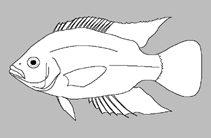
Espinas dorsales (total) : 15 - 16; Radios blandos dorsales (total) : 6 - 7; Espinas anales: 3; Radios blandos anales: 6 - 7; Vértebra: 24. Apistogramma ortegai belongs to Apistogramma regani species group, sharing exclusively with A. commbrae (Regan, 1906); A. inconspicua, 1983; and A. linkei, 1985 a tail spot (contiguous caudal spot to bar 7). It can be distinguished from A. commbrae by the absence of vertical stripes on caudal fin (vs. presence); from A. inconspicua by absence of vertical stripes on caudal fin (vs. presence) and by lateral band running into tail spot (vs. lateral band ending in bar 6); from A. linkei by absence of vertical stripes on caudal fin (vs. presence of two vertical stripes posteriorly) and by horizontal abdominal stripes (vs. vertical abdominal stripes). It can be diagnosed from other species with similar general counts, body shape and similar basic melanic color pattern, with exception of the contiguous caudal spot to bar 7: from A. eunotus by having 7-8 predorsal scales (vs. 9-12), 6-8 prepelvic scales (vs. 9-13) and presence of abdominal stripes (vs. absence); from A. cruzi by having 6-8 prepelvic scales (vs. 9-13); from A. aguarico by its dorsal-fin lappets short (vs. five first dorsal-fin lappets elongated) (Ref. 97388).
Body shape (shape guide): fusiform / normal.
Occurs along the margin of a small stream tributary to the Ampyiacu River in the municipality of Pebas. The stream is characterized by clear and acid water with pH 6.0, water temperature 26°C, depth of at most 50 cm and bottom substrate mainly composed of sand and leaves, with some clay. Collected together with Apistogramma bitaeniata, Bujurquina peregrinabunda, Crenicichla sp., Cichlasoma amazonarum, Acestrocephalus sp., Astyanax bimaculatus, Characidium sp., Knodus sp., Leporinus sp. aff. friderici, Moenkhausia margitae, Moenkhausia oligolepsis, Pyrrhulina semifasciata, Corydoras fowleri, Ituglanis sp., Rhamdia sp., Gymnotus sp., and Sternopygus macrurus (Ref. 97388).
Ciclo vital y comportamiento de apareamiento
Madurez | Reproducción | Puesta | Huevos | Fecundidad | Larva
Britzke, R., C. Oliveira and S.O. Kullander, 2014. Apistogramma ortegai (Teleostei: Cichlidae), a new species of cichlid fish from the Ampyiacu River in the Peruvian Amazon basin. Zootaxa 3869(4):409-419. (Ref. 97388)
Situación en la Lista Roja de la UICN (Ref. 130435: Version 2025-2 (Global))
Amenaza para el ser humano
Harmless
Usos humanos
Herramientas
Informes especiales
Descargar XML
Fuentes de Internet
Estimaciones basadas en modelos
Índice de diversidad filogenética (Referencia
82804): PD
50 = 0.5000 [Uniqueness, from 0.5 = low to 2.0 = high].
Bayesian length-weight: a=0.01820 (0.00837 - 0.03955), b=2.99 (2.82 - 3.16), in cm total length, based on LWR estimates for this Genus-body shape (Ref.
93245).
Nivel trófico (Referencia
69278): 3.3 ±0.4 se; based on size and trophs of closest relatives
Resiliencia (Referencia
120179): Alto, población duplicada en un tiempo mínimo inferior a 15 meses (Preliminary K or Fecundity.).
Vulnerabilidad pesquera (Ref.
59153): Low vulnerability (10 of 100).
🛈