การจำแนกประเภท / ชื่อ
ชื่อสามัญ | ชื่อพ้อง | Catalog of Fishes(สกุล, ชนิด) | ITIS | CoL | WoRMS | Cloffa
>
Siluriformes (Catfishes) >
Auchenipteridae (Driftwood catfishes) > Centromochlinae
Etymology: Centromochlus: Greek, kentron = sting + Greek, mochlos, -ou = lever, crowbar (Ref. 45335); melanoleucus: Derived from the Greek melano, meaning black, and leukos, meaning white, in allusion to its black-and-white color pattern. An adjective.
สิ่งแวดล้อม : สิ่งแวดล้อม / เขตภูมิอากาศ / ระดับความลึก / ระยะการกระจายสินค้า
นิเวศวิทยา
; น้ำจืด กลุ่มสัตว์หน้าดิน,กลุ่มสัตว์พื้นท้องน้ำ. Tropical
South America: Rio Teles Pires, upper rio Tapajós basin in Brazil.
ขนาด / น้ำหนัก / อายุ
วัยเจริญพันธุ์: Lm ? range ? - ? cm
Max length : 3.2 cm SL เพศผู้/กระเทย; (Ref. 97857)
คำอธิบายสั้นๆ
เครื่องมือที่ใช้ในการแยกชนิดสัตว์,สิ่งมีชีวิตออกจากกัน | สัณฐานวิทยา | ความยาวต่างๆ
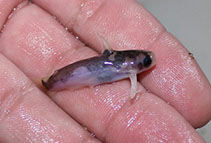
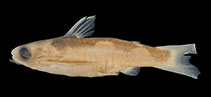
เงี่ยงครีบหลัง (รวม) : 2; ก้านครีบอ่อนที่หาง (รวม) : 5; ก้านครีบอ่อนที่ก้น: 10; สัตว์มีกระดูกสันหลัง: 34. Tatia melanoleuca is readily distinguished from all congeners, except T. carolae and T. musaica, by the strongly contrasting, dark coloration on the dorsal and to varying degrees lateral and ventrolateral portions of the body that is distinctly demarcated from the lightly colored regions that are translucent in life on the remainder of the body (vs. a variety of alternative coloration patterns in congeners, none of which is comparable to this pigmentation pattern). It differs from T. musaica and T. carolae by the lack of dark pigmentation on the lower lobe of the caudal fin (vs. a bilobed pattern of dark pigmentation in that region in T. carolae, or an extension of the dark body pigmentation onto the basal portions of the lobe in T. musaica) and having 34 vertebrae (vs. 35 or 36 in T. carolae and 35 in T. musaica). In addition, it is distinct from T. carolae in the dark pigmentation that is uniformly continuous across the portion of the lateral line on the caudal peduncle (vs. with the area bordering the lateral line unpigmented and forming distinct, narrow, posteriorly dorsally angling white stripe within the dark pigmentation on the caudal peduncle), the lack of dark pigmentation on the upper lobe of the caudal fin or with such pigmentation barely extending onto the lobe (vs. a bilobed pattern of dark pigmentation extending onto the lobe in that region), the narrower interorbital width (42.0-42.9% vs. 51.8-62.4% HL), shallower snout depth (34.5-38.5% vs. 43.4-47.5% HL), shorter posterior internarial distance (26.0-29.8% vs. 33.7-38.8% HL) and shorter caudal-peduncle length (18.8-19.5% vs. 22.5-25.3% SL). It further differs from T. musaica in having the following characters: an unpigmented region anterodorsal of the orbits either in the form of a rounded spot or a broad median band extending anteriorly to the upper lip (vs. with solid dark pigmentation in that region), the unpigmented dorsal-fin spine (vs. a dusky spine), the lack of dark pigmentation on the dorsal surface of the pectoral-fin spine other than basally (vs. dusky pigmentation extending at least one-half the length of the spine), the location of dark pigmentation on the body other than on the caudal-peduncle dorsal to the horizontal through the middle of the orbit (vs. dark pigmentation broadly extending ventral of that line and reaching to the ventral midline anterior to the anal-fin base), the deeper overall body as reflected in the greatest body depth (23.4-25.6% vs.17.9-21.8% SL) and deeper caudal-peduncle depth (13.9-14.5% vs. 9.6-12.0% SL) (Ref. 97857).
Body shape (shape guide): fusiform / normal.
Found in a 2 m deep stretch of the river (Rio Jamanxim) characterized by clear water, somewhat lentic to slow flowing waters and substrate composed primarily of sand and rocks with some submerged tree trunks. Collected near the river margin during twilight while searching for food on the water surface (Ref. 97857).
วงจรชีวิตและพฤติกรรมการผสมพันธุ์
วัยเจริญพันธุ์ | การสืบพันธุ์ | การวางไข่ | เซลสืบพันธ์ของเพศเมีย(ไข่) | ความดกของไข่ | ตัวอ่อน
Vari, R.P. and B.B. Calegari, 2014. New species of the catfish genus Tatia (Siluriformes: Auchenipteridae) from the rio Teles Pires, upper rio Tapajós basin, Brazil. Neotrop. Ichthyol. 12(4):667-674. (Ref. 97857)
สถานะบัญชีแดงของ IUCN (Ref. 130435: Version 2025-2 (Global))
ภัยคุกคามต่อมนุษย์
Harmless
การใช้ของมนุษย์
เครื่องมือ
รายงานพิเศษ
ดาวน์โหลด XML
แหล่งที่มาจากอินเตอร์เน็ต
การประมาณค่าตามแบบจำลอง
ดัชนีความหลากหลายทางวิวัฒนาการ (อ้างอิง
82804): PD
50 = 0.5078 [Uniqueness, from 0.5 = low to 2.0 = high].
Bayesian length-weight: a=0.01122 (0.00514 - 0.02450), b=3.04 (2.87 - 3.21), in cm total length, based on all LWR estimates for this body shape (Ref.
93245).
ระดับชั้นอาหาร (อ้างอิง
69278): 3.1 ±0.4 se; based on size and trophs of closest relatives
ความสามารถในการกลับคืนสู่ปกติ (อ้างอิง
120179): ความสูง, เวลาต่ำสุดที่จะทำให้ประชากรเพิ่มขึ้นเป็น 2 เท่าใช้เวลาน้อยกว่า 15 เดือน (Preliminary K or Fecundity.).
ความเสี่ยงต่อการตกปลา (Ref.
59153): Low vulnerability (10 of 100).
🛈