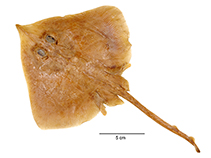
Elasmobranchii (haaien en roggen) (sharks and rays) >
Rajiformes (Skates and rays) >
Rajidae (Skates)
Etymology: ornata: Name from Latin 'ornatus' meaning ornate, for its dorsal color pattern of dark brown spots encircled with beige pigment and arranged into rosettes.
Milieu: milieu / Klimaatzone / Diepte / verspreidingsgebied
Ecologie
marien benthopelagisch; diepte ? - 390 m (Ref. 101518). Tropical
Northwestern Indian Ocean: upper slope off Socotra Islands, south of Yemen and east of the Horn of Africa.
Grootte / Gewicht / Leeftijd
Maturiteit: Lm ? range ? - ? cm
Max length : 41.8 cm TL mannelijk / geslacht onbekend; (Ref. 101518); 50.9 cm TL (female)
Korte beschrijving
Determinatiesleutels | Morfologie | Morfometrie
This species is distinguished by the following characters: disc rhombic to evenly inverse heart-shaped (in adult male), with angled outer corners, its body length to mid-vent shorter than tail length from mid-vent; preorbital snout length 13-15% and distance between first gill slits 15-16% of TL; orbits are large, horizontal diameter 1.1-1.4 times interorbital width; young specimens with 1-3 rows of tail thorns, adults 3-5; more than two interdorsal and nuchal thorns; dorsally, it is largely smooth, but snout tip prickly; with growth, dermal denticles also on anterior margins of disc and inner posterior pectorals, as well as ventrally on snout and anterior margins of disc; ventral snout tip blackish, especially in young specimens; dorsal ground color ocher, anterior snout dusky; its dorsal pattern on disc and pelvic fins consisting of variable dark brown spots encircled with beige pigment and arranged into rosettes; ventral pores are few, tiny, and blackish; long interdorsal and postdorsal tail sections, with high posterior part of epichordal caudal lobe and light edged low ventral keel; 37-42 upper tooth, relatively few pectoral fin radials (71-75); clasper without external pseudosiphon and funnel; inner dorsal lobe with components slit, terminal bridge, and 2 clefts; inner ventral lobe with components shield, dike, rhipidion, sentinel, spike, and two sentinas; terminal clasper skeleton with 3 dorsal terminal, 1 ventral terminal, and 2 accessory terminal cartilages; unlike its congener, its ventral terminal is atypically broad distally, the accessory terminal 1 is only slightly Y-shaped, and the dorsal terminal 2 and the terminal bridge are fused; anterior cranial fontanel with clear-cut contour all around and extending about one fifth into rostral shaft length; subrectangular scapulocoracoid, with rear corner sharply marked; large oval anterior fenestra without anterior bridge, one large oval postdorsal and one lower, moderately large oval postventral fenestra; its pelvic girdle with massive ischiopubic bar with weakly convex anterior contour, posterior contour slightly concave in females and juvenile males but deeply concave in semi adult and adult males; prepelvic processes are moderately long, solid, conical, and straight, their length 2.4-2.9 times median thickness of ischiopubic bar (Ref. 101518).
Cross section: flattened.
Levenscyclus en paargedrag
Maturiteit | Voortplanting | Paaien | Eieren | Fecunditeit | Larven
Weigmann, S., M.F.W. Stehmann and R. Thiel, 2015. Okamejei ornata n. sp., a new deep-water skate (Elasmobranchii, Rajidae) from the northwestern Indian Ocean off Socotra Islands. Deep-Sea Res. 115:18-29. (Ref. 101518)
Status op de Rode Lijst van het IUCN (Ref. 130435: Version 2025-2 (Global))
Gevaar voor de mens
Harmless
Gebruik door de mens
Visserij: bycatch
Tools
Speciale rapporten
Download XML
Internetbronnen
Schattingen op basis van modellen
Fylogenetische diversiteitsindex (Ref.
82804): PD
50 = 0.5001 [Uniqueness, from 0.5 = low to 2.0 = high].
Bayesian length-weight: a=0.00302 (0.00141 - 0.00645), b=3.24 (3.07 - 3.41), in cm total length, based on LWR estimates for this (Sub)family-body shape (Ref.
93245).
Trofisch niveau (Ref.
69278): 4.0 ±0.6 se; based on size and trophs of closest relatives
Weerstandsvermogen (Ref.
120179): laag, minimale populatieverdubbelingstijd 4,5-14 jaar (Preliminary low fecundity).
Kwetsbaarheid van de visserij (Ref.
59153): Moderate vulnerability (40 of 100).
🛈