Klassificering / Namn
Populärnamn | synonymer | Catalog of Fishes(Släkte, Arter) | ITIS | CoL | WoRMS | Cloffa
>
Cichliformes (Cichlids, convict blennies) >
Cichlidae (Cichlids) > Pseudocrenilabrinae
Etymology: Maylandia: In honour of Hans J. Mayland, German ictiologist (Ref. 45335); tarakiki: The name tarakiki, from Swahili, means slim or slender to note the elongate body shape of this species (Ref. 93436).
Eponymy: Hans-Joachim Mayland (1928–2004) was a German ichthyologist, aquarist, photographer and writer. [...] (Ref. 128868), visit book page.
Miljö: miljö / Klimatzon / djupintervall / distributionsområde
Ekologi
; sötvatten pelagiska. Tropical
Africa: Lake Malawi (Ref. 93436).
Storlek / Vikt / Ålder
Könsmognad: Lm ? range ? - ? cm
Max length : 11.9 cm SL hane/ej könsbestämd; (Ref. 93436)
Kort beskrivning
Bestämningsnycklar | Morfologi | Morfometri
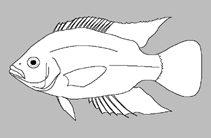
Taggstrålar i ryggfenan (totalt) : 17 - 19; Mjukstrålar i ryggfenan (totalt) : 8 - 10; Taggstrålar i analfenan: 3; Mjukstrålar i analfenan: 8 - 9. Diagnosis: The presence of bicuspid teeth in the anterior portion of the outer row on both the upper and lower jaws and a moderately sloped ethmo-vomerine block with a swollen rostral tip place this species in Maylandia (Ref. 93436). Male Maylandia tarakiki are distinguished from those of the other members of Maylandia by the blue ground colour with distinct black bars, the extension of the lateral bars onto the blue dorsal fin, the blue anal fin, and the absence of a dark submarginal band in the dorsal fin or yellow pigment on the body; while some males of M. zebra and M. fainzilberi exhibit extension of the lateral bars into the dorsal fin, these extensions fuse into a broad submarginal band, which is not observed in males of M. tarakiki (Ref. 93436). Male and female M. tarakiki are further distinguished from M. zebra by a shallower body as expressed in the distance between the dorsal fin origin and pelvic fin which ranges from 28,1-36,0% of standard length in M. tarakiki and from 34,2-40,7% of standard length in M. zebra populations from the Tanzanian shores and from Chiwindi in Mozambique (Ref. 93436). On average M. tarakiki has more tooth rows on the lower jaw, range 5-8, than M. zebra, range 3-5 (Ref. 93436).
Body shape (shape guide): fusiform / normal; Cross section: oval.
Livscykel och parningsbeteende
Könsmognad | Reproduktion | Lek | Ägg | Fekunditet | Larver
Stauffer, J.R., K. Black and A.F. Konings, 2013. Descriptions of five new species of Metriaclima (Teleostei: Cichlidae) from Lake Malaŵi, Africa. Zootaxa 3647(1):101-136. (Ref. 93436)
Status på IUCN:s rödlista (Ref. 130435: Version 2025-2 (Global))
Hot mot människor
Harmless
Mänskliga användningsområden
Verktyg
Särskilda rapporter
Ladda ner XML
Internet-källor
Uppskattningar baserade på modeller
Index för fylogenetisk mångfald (Ref.
82804): PD
50 = 0.5000 [Uniqueness, from 0.5 = low to 2.0 = high].
Bayesian length-weight: a=0.00389 (0.00180 - 0.00842), b=3.12 (2.94 - 3.30), in cm total length, based on all LWR estimates for this body shape (Ref.
93245).
Resiliens (Ref.
120179): Hög, lägsta populationsfördubblingstid mindre än 15 månader (Preliminary K or Fecundity.).
Sårbarhet i fisket (Ref.
59153): Low vulnerability (10 of 100).
🛈