Klassifizierung / Names
Namen | Synonyme | Catalog of Fishes(Gattung, Arten) | ITIS | CoL | WoRMS | Cloffa
>
Siluriformes (Catfishes) >
Auchenipteridae (Driftwood catfishes) > Centromochlinae
Etymology: Gelanoglanis: Greek, gelanes, -es, -es = happy, smiling + Greek, glanis = a fish that can eat the bait without touching the hook; a cat fish (Ref. 45335); pan: From the name of the Greek God of fertility and male sexuality, in reference to the large gonopodium of the males of the species.
Eponymy: Pan was the Greek God of fertility and male sexuality. [...] (Ref. 128868), visit book page.
Umwelt: Milieu / Klimazone / Tiefenbereich / Verbreitungsgebiet
Ökologie
; süßwasser benthopelagisch. Tropical
South America: Rio Teles Pires, a tributary to the upper rio Tapajós basin in Brazil.
Größe / Gewicht / Alter
Geschlechtsreife: Lm ? range ? - ? cm
Max length : 2.5 cm SL Männchen/unbestimmt; (Ref. 97849)
Kurzbeschreibung
Bestimmungsschlüssel | Morphologie | Morphometrie
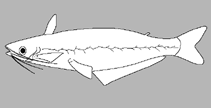
Rückenflossenstacheln (insgesamt) : 2; Rückenflossenweichstrahlen (insgesamt) : 7; Afterflossenweichstrahlen: 9; Wirbelzahl: 34. Gelanoglanis pan can be distinguished from all congeners by the following characters: anterior middorsal fontanel situated between the anterior portions of the contralateral frontals present (vs. the frontals conjoined along the entirely of their middorsal margins and the fontanel
absent); long fleshy, tubular gonopodium extending posteriorly to a point midway along the length of the anal fin in adult males (vs. the gonopodium reaching only to, or slightly beyond, the anal-fin origin in G. travieso and G. stroudi or falling short of the anal-fin
origin in G. nanonocticolus); and deeper caudalpeduncle 12.1-13.5% SL (vs. 9.5-12.0% in G. stroudi, 10.2-11.6% in G. nanonocticolus, and 9.4-11.7% in G.
travieso). It can be diagnosed G. stroudi and G. travieso by the following characters: premaxillary teeth occupying one-half or less of length of premaxilla and restricted to the its more vertically expansive anterior portion (vs. the teeth distributed along most of the dentigerous margin of premaxilla and occupying two-thirds of length of the bone); the portion of the maxilla inside the base of the maxillary barbel shorter and terminating posteriorly forward of the anterior margin of the opercle (vs. maxilla terminating posteriorly to the middle of the opercle); and larger orbital diameter 14.4-17.9% HL (vs. 7.2-9.3% in G. stroudi and 8.2-12.8% in G. travieso). It further differs from G. nanonocticolus by the presence of well-developed serrae on pectoral- and dorsal-fin spines (vs. vs. absence).
Lebenszyklus und Paarungsverhalten
Geschlechtsreife | Fortpflanzung | Ablaichen | Eier | Fruchtbarkeit | Larven
Calegari, B.B., R.E. Reis and R.P. Vari, 2014. Miniature catfishes of the genus Gelanoglanis (Siluriformes: Auchenipteridae): monophyly and the description of a new species from the upper rio Tapajós basin, Brazil. Neotrop. Ichthyol. (Ref. 97849)
IUCN Rote Liste Status (Ref. 130435: Version 2025-2 (Global))
Bedrohung für Menschen
Harmless
Nutzung durch Menschen
Tools
Zusatzinformationen
Download XML
Internet Quellen
Schätzungen auf der Grundlage von Modellen
Phylogenetischer Diversitätsindex (Ref.
82804): PD
50 = 0.5625 [Uniqueness, from 0.5 = low to 2.0 = high].
Bayesian length-weight: a=0.00490 (0.00199 - 0.01208), b=3.10 (2.88 - 3.32), in cm total length, based on LWR estimates for this (Sub)family-body shape (Ref.
93245).
Trophische Ebene (Ref.
69278): 3.1 ±0.4 se; based on size and trophs of closest relatives
Widerstandsfähigkeit (Ref.
120179): hoch, Verdopplung der Population dauert weniger als 15 Monate. (Preliminary K or Fecundity.).
Anfälligkeit der Fischerei (Ref.
59153): Low vulnerability (10 of 100).
🛈